32 Amp vs 40 Amp EV Charger: Which Fits Your Home? (November 2026)
Pick a 40 amp charger if your home has a 50A circuit and a NEMA 14-50 outlet, and pick a 32 amp model if your wiring or daily driving is lighter. The 40 amp unit charges faster, but only when your panel and outlet support it.
On this page (7 sections)
- 32 amp vs 40 amp EV charger: what's the real difference?
- Which outlet and circuit does each one need?
- Which charger fits your car's connector?
- How much faster is 40 amp charging in daily use?
- What do these chargers cost to run?
- Who should buy which charger?
- Which should you pick in the 32 amp vs 40 amp ev charger decision?
Pick a 40 amp charger if your home has a 50A circuit and a NEMA 14-50 outlet, and pick a 32 amp model if your wiring or daily driving is lighter. The 40 amp unit charges faster, but only when your panel and outlet support it.
The 32 amp option is the safer fit for older panels, smaller circuits and drivers who top up overnight.
The 32 amp vs 40 amp ev charger question really comes down to three things: how fast you need to charge, what your electrical panel can supply, and whether your car can use the extra current. This comparison checks those points against three real chargers so you can decide.
The 32 amp group here covers a Tesla-specific model and a portable unit for any J1772 car. The 40 amp pick is a wall charger for non-Tesla EVs.
Each one fits a different home and a different driver.


32 amp vs 40 amp EV charger: what's the real difference?
A 40 amp charger delivers about 9.6 kW and a 32 amp charger about 7 to 7.7 kW, so the 40 amp unit adds more range per hour. That's roughly a third more power at the top end, though your car's onboard charger caps what it can accept.
Amps measure current. At 240 volts, 32 amps works out to about 7.7 kW and 40 amps to about 9.6 kW.
In practice, the car's onboard charger decides how much of that it takes.
Many EVs accept 32 amps or more on Level 2. Some smaller models and plug-in hybrids max out lower, so a 40 amp charger won't charge them faster than a 32 amp one.
The difference shows up over a full charge. A car with a 75 kWh battery needs roughly 10 hours at 32 amps and about 8 hours at 40 amps.
For overnight charging, both usually finish before morning.
Charging speed in miles per hour
EVDANCE says its 32 amp charger adds around 24 miles of range in about an hour on a Kia EV6. A 40 amp unit would add more on the same car, but the gain depends on efficiency.
The chart below gives you a rough sense of how the two levels compare. Use it to match the charger to how many miles you drive in a day.
| Charger level | Current | Power | Typical range added per hour |
|---|---|---|---|
| 32 amp Level 2 | 32A | About 7.7 kW | 20 to 25 miles |
| 40 amp Level 2 | 40A | About 9.6 kW | 25 to 31 miles |
Those numbers assume a car that accepts the full current. A car capped at 32 amps adds the same miles either way.
Which outlet and circuit does each one need?
Both need a 240V outlet, but a 40 amp charger needs a dedicated 50A circuit while a 32 amp unit can run on a smaller one. Check your panel before you buy, because the breaker sets the limit.
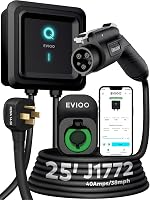
The EVIQO 40A charger plugs into a 4-prong NEMA 14-50 outlet on a dedicated 50A circuit. That's the RV and range outlet type, not a dryer outlet.
The EVIQO's app lets you turn current down from 40A to as low as 6A.
The VDLPOWERVP and EVDANCE chargers use the same NEMA 14-50 plug at 32 amps. The EVDANCE model goes further: its current adjusts to 16A, 24A or 32A to match your breaker.
The electrical rule is simple. A continuous load should stay at 80 percent of the breaker rating.
That means a 50A breaker supports 40 amps and a 40A breaker supports 32 amps.
Check your panel first
Look at the breaker feeding the outlet. A 50A breaker clears a 40 amp charger.
A 40A breaker limits you to 32 amps, so the adjustable EVDANCE or the app-controlled EVIQO makes more sense.
If the outlet isn't there yet, an electrician can tell you whether the panel has spare capacity. A panel upgrade adds cost and time, and a smaller charger can avoid it.
A portable 32 amp unit also works on the road. Plug it into a 14-50 outlet at an RV park or a friend's garage.
A wall charger stays put.
What if you only have a dryer outlet?
A dryer outlet is usually a 10-30 or 14-30, and neither matches a 14-50 plug. Don't force an adapter.
Have an electrician install the right outlet or choose a charger built for that circuit.
The 32 amp vs 40 amp ev charger choice assumes a 14-50 outlet. If you can't add one, a 32 amp charger on a smaller circuit is the realistic path.
Which charger fits your car's connector?
The VDLPOWERVP is built for Tesla cars, while the EVIQO and EVDANCE use the J1772 connector that fits most other EVs. Match the plug to your car and you avoid adapters and slow surprises.
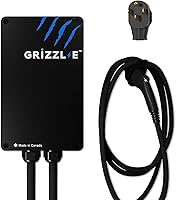
The VDLPOWERVP 32Amp has the Tesla connector and works with Models Y, X, 3 and S plus plug-in hybrids on the North American standard. Its one-touch lid opening works from up to 2 meters away.
The EVIQO 40A uses a standard J1772 connector. EVIQO says it fits Ford, Chevrolet, Hyundai, Kia, Nissan, BMW, Volkswagen, Audi, Rivian and Lucid cars without an adapter.
Tesla drivers can use the J1772 adapter that comes with the car.
The EVDANCE 32A portable also uses J1772. Tesla owners need a J1772-to-Tesla adapter, which isn't included.
Check your car's port before ordering.
Tesla owners
Go with the VDLPOWERVP if you drive a Tesla and want the native connector. It's the highest score here because it does one job well: simple 32 amp charging for Tesla cars.
For more on 40 amp options that suit other cars, see our roundup of the best 40 amp EV chargers.
Non-Tesla owners
The EVIQO 40A is the natural pick for a J1772 car when your panel allows 40 amps. Its app control and adjustable current give you room to manage load.
Our Emporia 48 amp Level 2 review covers a higher-output option if you're weighing bigger chargers.
The EVDANCE 32A portable suits renters and drivers who move between homes. It's the lightest-duty pick of the three.
How much faster is 40 amp charging in daily use?
For most drivers, a 32 amp charger already covers a night's driving, so the 40 amp speed gain matters mainly for long commutes and short turnaround. Decide by your daily miles, not by the headline wattage.
The average driver covers 30 to 40 miles a day. A 32 amp charger adds about 20 to 25 miles per hour, so two hours of charging covers a typical day.
A driver covering 100 miles a day needs roughly 4 to 5 hours at 32 amps. A 40 amp charger cuts that to about 3 to 4 hours.
Both fit an overnight window for most people.
The gap matters when you arrive home late and leave early. It also matters if two people share one charger and both need a full battery by morning.
When 40 amps earns its place
Pick the 40 amp EVIQO if you drive long distances often, share the charger, or want the fastest charge your 50A circuit allows. The extra speed is real, and the app makes it easy to schedule off-peak hours.
A 32 amp charger makes more sense if your commute is short or your panel can't spare 50 amps. The VDLPOWERVP or EVDANCE keeps installation simpler.
If you're already thinking about going bigger, read our 40 amp vs 48 amp EV charger comparison to see when 48 amps is worth the extra wiring.
What do these chargers cost to run?
A 40 amp charger uses more power per hour, but the cost depends on your electricity rate and how long you charge, not on the amperage alone. The charger doesn't waste more energy just because it's faster.
At 240 volts, 32 amps draws about 7.7 kW and 40 amps about 9.6 kW. If your rate is 15 cents per kWh, an hour at 32 amps costs about 1.15 dollars and an hour at 40 amps about 1.44 dollars.
You buy the same energy either way for the same miles. The 40 amp charger just delivers it in less time.
A full charge costs roughly the same.
The EVIQO app tracks energy use and cost. Scheduling off-peak charging can cut the bill.
The EVDANCE screen shows real-time amperage and voltage, and its delay setting lets you start later.
The VDLPOWERVP shows charging status and errors through LED indicators. A lower amperage setting on the EVDANCE can also reduce heat.
Smart features that affect cost
WiFi control is the big cost lever. The EVIQO's app lets you set speed from 6A to 40A and schedule overnight charging.
That's useful if your utility charges less at night.
The EVDANCE has a delay setting and an LED screen but no app control. You set the schedule at the unit.
The VDLPOWERVP has no scheduling feature, so it charges when you plug in.
Who should buy which charger?
Buy the VDLPOWERVP for a Tesla on a 32 amp budget, the EVIQO for a J1772 car on a 50A circuit, and the EVDANCE for renters who need to move their charger. The right pick depends on your car, your panel and your home.
Buy the VDLPOWERVP if you drive a Tesla
The VDLPOWERVP Level 2 Tesla Charger 32Amp earns the top score of 9.7 here. It's a 32 amp unit with a Tesla connector, a 20 ft cable and a NEMA 14-50 plug.
It fits Tesla Models Y, X, 3 and S and plug-in hybrids. The one-touch lid opening from up to 2 meters makes plugging in easier, especially in a tight garage.
It also has over-current, over-voltage, leakage and overheat protection. VDLPOWERVP says it works from -22°F to 130°F.
If your panel gives you 32 amps and you drive a Tesla, this is the straightforward choice.
Buy the EVIQO if you want 40 amps and app control
The EVIQO 40A NEMA 14-50 J1772 Charger scores 8.3. It's the only 40 amp unit here and the pick for non-Tesla EVs on a 50A circuit.
EVIQO says it's certified by UL, ETL and FCC and carries an Energy Star rating. The IP66 housing handles rain, snow and dust, and the holster glows in the dark.
The app sets current from 6A to 40A and schedules off-peak charging. A 25 ft cable gives you more reach than the Tesla unit's 20 ft.
Pick it when speed and smart control matter more than the lowest install cost.
Buy the EVDANCE if you rent or move between homes
The EVDANCE 32A Portable Level 2 Charger scores 7.2. It's the most flexible of the three for people who can't install a fixed charger.
Current adjusts to 16A, 24A or 32A to match the breaker. A 25 ft cable and a wall bracket come in the box, along with a carry bag for travel.
Its IP66-rated housing is built for garage and covered outdoor use.
EVDANCE says its 25 ft cable is tested to withstand more than 10,000 insertions. The LED screen shows amperage, voltage, speed and delay settings.
Pick it if portability and breaker flexibility top your list.
Compare the three at a glance
| Charger | Amps | Connector | Best for |
|---|---|---|---|
| VDLPOWERVP Level 2 Tesla Charger 32Amp | 32A | Tesla | Tesla owners |
| EVIQO 40A NEMA 14-50 J1772 Charger | 40A | J1772 | Non-Tesla EVs on a 50A circuit |
| EVDANCE 32A Portable Level 2 Charger | 32A | J1772 | Renters and portable use |
Which should you pick in the 32 amp vs 40 amp ev charger decision?
For most readers, the VDLPOWERVP 32Amp is the best overall pick because it pairs a solid 32 amp charge with a Tesla connector and a simple setup. Pick the EVIQO 40A when your panel supports 50 amps and you want faster charging plus app control.
Pick the EVDANCE 32A portable when you rent or move between homes.
The 32 amp vs 40 amp ev charger choice is really about your wiring. A 50A circuit and a 14-50 outlet make the 40 amp EVIQO possible.
Anything less favors the 32 amp models.
If you drive a Tesla, the connector decides it: the VDLPOWERVP fits without an adapter. If you drive a J1772 car and your panel allows it, the EVIQO's extra speed and scheduling are worth it.
Before you buy, check your breaker, your outlet type and your car's port. Then match the amperage to what your home can safely supply.
For the charger you'll plug in overnight, the right fit beats the bigger number.
If you want a level that sits below both of these, our Lectron Level 1 EV charger review covers the slower 120V option. For a step up in speed, weigh 40 amps against 48 before you commit to new wiring.
Frequently asked questions
Is a 40 amp EV charger faster than a 32 amp charger?
Yes. A 40 amp Level 2 charger delivers about 9.6 kW, while a 32 amp unit delivers about 7 to 7.7 kW.
That gap means the 40 amp charger adds more miles of range per hour, though the exact gain depends on your car's onboard charger and how full the battery is.
What outlet does a 40 amp EV charger need?
A 40 amp charger needs a dedicated 50A circuit with a NEMA 14-50 outlet. The 14-50 is the four-prong RV and range outlet, not a dryer outlet.
A 32 amp charger also runs on a NEMA 14-50, but some models can be set lower to match smaller breakers.
Can I use a 40 amp charger on a 40A circuit?
No. A 40 amp charger needs a 50A circuit because continuous loads run at 80 percent of the breaker rating.
On a 40A circuit, the safe continuous load is 32 amps, so a 32 amp charger or a 40 amp model turned down to 32A is the right fit.
How long does a 32 amp charger take to charge an EV?
EVDANCE says a 32 amp charger takes about 8 to 13 hours to fill an EV battery from empty. A 40 amp charger shortens that time by roughly a fifth on cars that accept the extra current.
Daily top-ups usually need far less than a full charge.
Does a 40 amp charger cost more to install than a 32 amp one?
Installation cost depends on your panel and wiring, not just the charger's amperage. Both need a 240V outlet, and a 50A circuit for a 40 amp unit may need heavier cable than a smaller circuit.
Get a quote from a licensed electrician before you buy.