40 Amp vs 48 Amp EV Chargers: Is 48 Worth It? (October 2026)
Choose a 40 amp charger for routine overnight charging and a 48 amp charger when your car and electrical setup can use the extra output. This 40 amp vs 48 amp EV charger comparison covers circuit needs, setup and which option fits your home.
On this page (10 sections)
- 40 amp vs 48 amp EV charger: which should you choose?
- How much faster is a 48 amp charger?
- What electrical setup does each charger need?
- What changes between plug-in and hardwired installation?
- Which 40 amp charger fits a plug-in setup?
- When is a 48 amp charger worth the added installation?
- What should you check before setting up a home charger?
- How do you use and care for the charger?
- Which should you choose for home charging?
- External references
A 40 amp charger is enough for many overnight charging routines, while a 48 amp charger can add speed when your vehicle and electrical circuit support it. This 40 amp vs 48 amp EV charger comparison comes down to your car’s AC charging limit, your panel capacity and how quickly you need to recharge.
The 48 amp option provides 20% more current at maximum output. That does not mean every charging session will be 20% shorter, since the vehicle sets its own charging limit and charging speed changes during a session.

40 amp vs 48 amp EV charger: which should you choose?
Choose 40 amps for a suitable plug-in setup and routine overnight charging; choose 48 amps when you need more output and can support hardwiring. Your circuit and vehicle matter as much as the charger’s maximum current.
A 40 amp charger at full output typically pairs with a dedicated 50 amp circuit. The EVIQO 48A specifies a dedicated 60 amp, 240V circuit and professional installation.
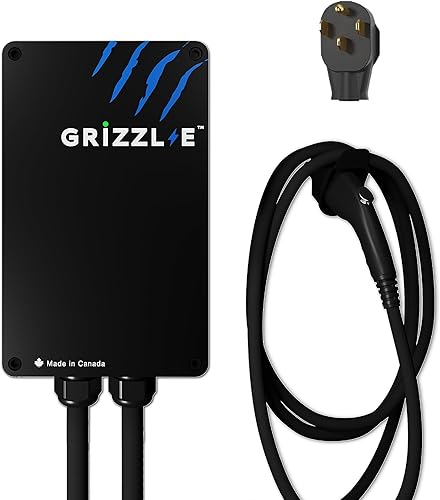
The Grizzl-E Classic and EVIQO 40A use a NEMA 14-50 plug. The Emporia and EVIQO 48A are hardwired, so decide which installation method fits your home before comparing app features or cable length.
For wiring and outlet choices, start with our guide to EV charger outlets. Our Level 2 charger for home guide explains how amperage, plugs and installation fit into a home charging decision.
How much faster is a 48 amp charger?
A 48 amp charger can supply up to 20% more current than a 40 amp charger when the vehicle can accept it. That difference matters most when your car supports the additional power and you need to add energy quickly.
At 240 volts, 40 amps works out to up to 9.6 kW, while 48 amps works out to up to 11.5 kW. These are approximate maximum outputs before charging losses, and the vehicle may draw less.
If your car’s onboard charger is capped below 40 amps, it cannot take full advantage of either charger. In that case, a 48 amp unit may not meaningfully shorten your charging time.
Battery size and the amount of energy you need to add also affect charging duration. A small top-up after a local commute is different from replenishing a low battery after a long drive.
Our guide to how long home EV charging takes covers the factors behind full and partial charging times. Compare your daily mileage and vehicle limit with your usual parking window to decide whether extra current will make a practical difference.
Does the 40 amp vs 48 amp EV charger gap matter overnight?
For many daily routines, the difference matters less when your vehicle is parked for several hours. If your usual overnight window replaces the energy you use during the day, the higher output may not change your routine.
The difference can be useful if you arrive home late, need a quick top-up before another trip, or share charging time with a second vehicle. Check your vehicle’s AC charging limit first, since the car needs to accept the additional power.
What electrical setup does each charger need?
A 40 amp charger at full output typically calls for a dedicated 50 amp circuit, while a 48 amp charger typically calls for a dedicated 60 amp circuit. Ask an electrician to confirm the panel, wiring, breaker and connection match the charger’s requirements.
EV charging is a continuous load, so the circuit needs capacity above the charger’s output. Do not assume that a breaker or outlet is suitable just because it fits.
The Grizzl-E Classic adjusts to 40A, 32A, 24A or 16A. Its maximum output pairs with a 50A circuit breaker, and the lower settings can fit installations designed for less output when set up according to the charger’s instructions.
The EVIQO 40A plugs into a 240V NEMA 14-50 outlet and specifies a dedicated 50A circuit for full output. Confirm that the outlet is the right type and rated for continuous EV charging.
The 48 amp Emporia and EVIQO models are hardwired. Emporia’s unit is configured for hardwired installation with a whip, and EVIQO specifies a dedicated 60A, 240V circuit for its 48A setting.
Before you buy, ask an electrician to assess available panel capacity and the path from the panel to the parking spot. Our EV charger load management guide explains how competing household loads can affect the decision.
Can you plug a 48 amp charger into a 14-50 outlet?
The two 48 amp chargers here are hardwired, not plug-in NEMA 14-50 models. A 14-50 setup has different equipment and circuit requirements, so don’t treat the outlet as a shortcut to 48 amp charging.
Do not adapt a hardwired charger to an outlet or increase breaker size to get more current. Match the charger, circuit and installation method, then have a qualified electrician confirm the plan.
What changes between plug-in and hardwired installation?
A plug-in 40 amp charger can be disconnected from a suitable outlet, while a hardwired 48 amp charger is a more permanent setup that can provide higher output. Installation method affects both flexibility and the work needed before charging.
A NEMA 14-50 charger can be unplugged for replacement or relocation, as long as the outlet and circuit are suitable. The Grizzl-E Classic offers adjustable output, while the EVIQO 40A adds app controls, schedules and energy tracking through 2.4 GHz Wi-Fi.
Hardwiring is better suited to a fixed charging location. Emporia’s 48A model comes configured with a whip for hardwired installation, and EVIQO recommends a licensed electrician for its hardwired 48A charger.
Installation work varies with the panel, cable route and mounting location. Get a quote for the circuit and charger position you need, rather than assuming the higher-output option is only a small step up from plug-in installation.
For more help choosing home equipment, see our guide to Level 2 chargers for home. If you’ve settled on an output range, compare our 40 amp charger picks and 48 amp charger picks.
Which 40 amp charger fits a plug-in setup?
The Grizzl-E Classic fits a flexible plug-in setup, while the EVIQO 40A suits drivers who want app scheduling and energy tracking. Both use J1772 connectors, so check your vehicle’s port and adapter needs before buying.
The Grizzl-E Classic offers four current settings, up to its maximum on a suitable circuit. Its 24 ft cable may reach across a shorter garage; measure from the planned mount to your vehicle’s charge port before choosing a location.
The EVIQO 40A uses a NEMA 14-50 outlet and a dedicated 50A circuit for full output. Its app can adjust charging speed from 6A to 40A and track energy use and cost; those features require 2.4 GHz Wi-Fi.
When is a 48 amp charger worth the added installation?
A 48 amp charger is a strong fit when your vehicle accepts the extra current, your panel supports a 60 amp circuit, and a shorter charging window helps your routine. If any of those conditions is missing, a 40 amp charger may be the more useful choice.
The Emporia 48A offers Wi-Fi energy data and charging schedules, and it is UL listed and ENERGY STAR certified. The EVIQO 48A also offers app controls and energy tracking, with a 25 ft cable and a dedicated 60A circuit specified for 48A charging.
Before choosing either model, check your vehicle’s maximum AC charging rate and have an electrician assess your panel. If the panel is near its limit, a lower charger setting or load management may be more practical than adding a larger circuit.
What should you check before setting up a home charger?
Check the vehicle connector, circuit plan, cable reach and mounting location before ordering. These details help prevent a charger from arriving that cannot connect to your vehicle or reach its parking spot.
First, confirm that your vehicle uses J1772 or has a compatible adapter. The four models here have J1772 connectors; Tesla drivers may need a J1772 adapter, so check your vehicle’s equipment and charging port.
Next, measure the cable route from the planned mount to the charge port, including the way around parked cars and garage obstacles. The Grizzl-E Classic has a 24 ft cable, while the EVIQO and Emporia models have 25 ft cables.
Then confirm whether your installation will be plug-in or hardwired, and whether the panel can support the required circuit. Ask the electrician to check the full installation, including the outlet where applicable, before you buy equipment.
If the charger will be outdoors, check the unit’s weather rating and choose a location that keeps the cable easy to reach and store. EVIQO describes both its 40A and 48A units as weatherproof, with sealed IP66 / NEMA 4 housings.
How do you use and care for the charger?
Use the current setting and charging schedule that match your circuit and routine, and keep the cable and connector stored neatly between sessions. Follow the charger instructions and avoid opening or modifying the unit.
On the Grizzl-E Classic, set the output to match the circuit and breaker arrangement confirmed for your installation. The charger supports lower settings as well as its maximum, which can be useful when a circuit is configured for less output.
For app-enabled EVIQO and Emporia models, connect to a 2.4 GHz Wi-Fi network if you want scheduling or energy information. A schedule can shift charging to the hours you select, while energy tracking helps you review charging use.
Return the connector to its holster after charging and route the cable so it is not pinched by a door or driven over. If a unit needs attention, use its controls and reset guidance in the manufacturer instructions instead of opening the housing.
Which should you choose for home charging?
Pick a 40 amp charger if overnight charging and a plug-in connection suit your home; pick a 48 amp charger if your car and electrical service can use the extra output. That’s the clearest way to decide in the 40 amp vs 48 amp EV charger comparison.
Choose the Grizzl-E Classic if you want adjustable current on a plug-in charger. Choose the EVIQO 40A if app schedules and energy tracking matter, and a suitable NEMA 14-50 circuit is already part of your plan.
Choose Emporia 48A or EVIQO 48A when you want a hardwired setup and an electrician confirms the circuit. Compare your vehicle’s AC limit and your daily charging window before paying for an installation that may not change how you charge.
For the final product comparison, browse our best 40 amp EV chargers and best 48 amp EV chargers.
External references
- U.S. Department of Energy: Electric Vehicle Charging at Home
- National Fire Protection Association: Electric Vehicle Safety
Frequently asked questions
Is a 48 amp EV charger faster than a 40 amp charger?
It can be, if your car accepts the extra power and the charger has a suitable circuit. A 48 amp charger offers 20% more current than a 40 amp charger, but charging speed also depends on the vehicle's onboard charger, battery and state of charge.
What size breaker does a 48 amp EV charger need?
A 48 amp charger generally needs a dedicated 60 amp circuit because EV charging is a continuous load. The EVIQO 48A model specifies a dedicated 60A, 240V circuit; have a licensed electrician assess your panel and installation.
Can a 40 amp EV charger use a 50 amp breaker?
The Grizzl-E Classic pairs 40A output with a 50A circuit breaker, while its adjustable settings allow lower output on smaller circuits. Follow the charger's instructions and have an electrician confirm the circuit and outlet are suitable for continuous EV charging.
Will a 48 amp charger make every EV charge faster?
No. Your vehicle's onboard charger limits how much AC power it can accept.
A car that tops out below 40A may not gain much from a 48A unit.
Check your vehicle's charging limits before paying for a higher-output installation.
Is a 40 amp charger enough for overnight charging?
For many drivers, 40A is enough to replenish a typical day of driving overnight, though the exact time depends on the vehicle and energy used. Compare your daily mileage with your car's charging rate using our home charging time guide.