How Does a Home EV Charger Work?
A home EV charger is a smart switch, not a battery charger. It pulls 240V AC from your electrical panel through a dedicated circuit and hands that power to your car's onboard charger, which converts it to DC and fills the battery.
On this page (10 sections)
- How does a home EV charger work from panel to battery?
- What is the difference between Level 1 and Level 2 home charging?
- How does the charger talk to your car?
- What does the onboard charger in the car do?
- How fast will a home EV charger charge your car?
- Plug-in or hardwired: how does the connection change the job?
- What safety features stop a home EV charger from overloading the circuit?
- How does a home EV charger fit into your daily routine?
- How does a home EV charger compare with public charging?
- How do you choose the right home EV charger for your setup?
A home EV charger works as a controlled power path, not a battery. It takes 240V AC from your electrical panel, runs it through safety checks and a pilot signal to the car, and lets the car's onboard charger turn that AC into DC for the battery.
The wall unit is the switch and the meter; the car does the conversion.
That split matters when you shop. The charger's amps set the ceiling, the car's onboard charger sets the actual rate, and the circuit in your panel sets what either can safely draw.
The rest of this guide follows the current from the breaker to the battery.
How does a home EV charger work from panel to battery?
Power starts at the breaker, runs through the charger, and ends at the car's onboard converter. Each stage has its own job and its own limit.
The charger is the part you buy and mount; the rest already lives in the car.
The chain runs like this:
- A dedicated 240V circuit feeds the charger, either through an outlet or a hardwired connection.
- The charger checks the ground, watches for faults and waits for the car to ask for power.
- A control pilot signal on the cable tells the car how many amps are available.
- The car's onboard charger converts AC to DC and manages the battery.
- The charger measures the energy delivered and reports it in its app.
Nothing in that list stores electricity. The wall unit is closer to a smart outlet with a conversation built in.
What is the difference between Level 1 and Level 2 home charging?
Level 1 uses a standard 120V outlet and adds a few miles per hour; Level 2 uses 240V and adds 25 to 40 miles per hour. The speed gap comes from voltage and current, not from a different kind of charger.
A Level 1 unit plugs into any household outlet and usually delivers about 1.2 to 1.4 kW. That suits a plug-in hybrid or a low-mileage commuter who parks overnight.
A Level 2 unit on a 40A circuit delivers about 9.6 kW, roughly eight times the power.
Level 2 also needs a dedicated circuit and, for a plug-in model, a 240V outlet such as a NEMA 14-50. That is the setup most daily drivers end up with, because it turns an overnight stop into a full battery.
How does the charger talk to your car?
A low-voltage pilot signal on the charging cable carries the conversation. The charger announces the amps it can supply, and the car answers with what it can accept.
The handshake keeps either side from pulling more than the circuit allows.
The connector also includes a proximity pin. It tells the charger when the plug is fully seated and stops power before the connector is pulled out.
If the signal is lost, the charger cuts power rather than leaving live pins exposed.
This is why a 40A charger on a 50A circuit is safe even when the car can only take 32A. The car requests less, and the charger supplies only that.
The rated amps are a limit, not a promise the car will use all of them.
What does the onboard charger in the car do?
The onboard charger turns AC into DC and decides the actual charge rate. It is built into the car and its size varies widely by model.
Some cars accept 7.2 kW, some 11 kW, and some 19 kW or more.
That is the number that caps your real-world speed. A 48A wall charger offers about 11.5 kW, but a car limited to 7.2 kW will draw only 7.2 kW no matter what you install.
Check the car's onboard charger rating before you pay for extra amps.
The car also manages the battery itself. It tapers the rate as the pack fills, watches temperature and stops at the set charge level.
The wall unit never overrides those decisions.
How fast will a home EV charger charge your car?
Speed depends on three numbers: the circuit amps, the charger's output and the car's onboard charger. The lowest of the three sets the pace.
In practice, the circuit and the car are the usual limits.
As a rough guide, a 40A Level 2 setup adds about 25 to 30 miles of range per hour, and a 48A setup adds up to about 35 to 40 miles. That is why most drivers finish a daily commute in two to four hours and a full charge overnight.
If you want the fastest home setup your car can use, the best 48 amp EV charger is where the hardwired options live. For most cars and most panels, a 40 amp EV charger already maxes out what the car will accept.
Plug-in or hardwired: how does the connection change the job?
A plug-in charger uses a 240V outlet; a hardwired charger connects straight to the circuit. Both deliver the same kind of power.
The difference is convenience, cost and how much current the install can carry.
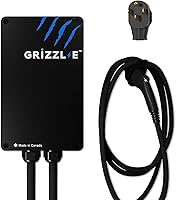
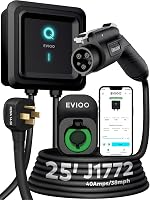
A plug-in model such as the {{product B0DD7KW73M | Plugs into a 4-prong NEMA 14-50 outlet on a dedicated 50A circuit and delivers up to 40A, with a 25 ft cable and app scheduling.}} needs the outlet already in place or added by an electrician. The upside is simple: unplug it and take it with you if you move.
A hardwired unit skips the outlet and usually supports higher amps. The {{product B0D9HV151X | Hardwired 48A unit that delivers up to 11.5 kW, with a mounting bracket and hardwire kit included.}} needs an electrician to open the panel, but it can reach 48A where a 14-50 outlet tops out at 40A.
Our guide to the hardwired EV charger for home covers when the extra wiring pays off.
If you want the simplest install and a portable unit, the {{product B082LMVSLY | 40A NEMA 14-50 plug-in with adjustable amperage down to 16A and a 24 ft cable, in a metal case rated IP67.}} is the low-fuss choice. It runs on a 50A circuit at full power or dials back on smaller breakers.
What safety features stop a home EV charger from overloading the circuit?
The charger and the car both watch the current, and the breaker backs them up. A fault anywhere in the chain cuts power before it becomes a hazard.
Certification is the quickest way to know those protections were checked.
Look for UL or ETL certification on the unit. Those marks mean the charger passed independent testing for ground faults, overcurrent and temperature.
An IP rating such as IP66 or a NEMA 4 or 4X enclosure adds weather protection for an outdoor mount.
The breaker is the last line of defense. A 40A charger belongs on a 50A circuit, and a 48A charger on a 60A circuit.
Sizing the breaker correctly is the electrician's job, and it is the one number you should never guess.
How does a home EV charger fit into your daily routine?
It turns parking into charging, mostly while you sleep. You plug in when you get home and the car is full by morning.
The charger's app or schedule does the timing so you don't have to think about it.
Set a start time after the evening peak and a stop time before you leave. Off-peak rates vary by utility, but the pattern is the same: the cheapest hours are usually late at night.
A scheduled session also keeps the battery from sitting full in hot weather.
The app on a connected unit shows energy used and cost per session. That data helps you spot a week when you drove more than usual or a schedule that started too early.
For a plain unit without an app, a smart plug or the car's own timer covers the same ground.
How does a home EV charger compare with public charging?
Home charging is slower but far more convenient and usually cheaper per mile. A public DC fast charger can add most of a battery in half an hour.
A home Level 2 unit takes hours, but it happens while the car sits unused.
The trade is time against routine. Almost every charge you need for daily driving can happen at home, so the fast charger becomes a road-trip tool rather than a weekly stop.
That is why most EV owners treat a Level 2 unit as the main charger and public stations as backup.
Home units also run on your household rate instead of a per-session public price. The exact savings depend on your utility and the local public rates, so compare your own bill against the stations you would otherwise use.
How do you choose the right home EV charger for your setup?
Match the charger to your panel, your car and your parking spot, in that order. The panel decides the amps, the car decides how much of them it can use, and the location decides plug-in versus hardwired and indoor versus outdoor.
Start with the circuit you can support. A 50A circuit fits a 40A plug-in charger, and a 60A circuit fits a 48A hardwired unit.
Then check the car's onboard charger rating so you don't buy amps the car can't accept.
Finally, check the connector. Most non-Tesla EVs use J1772, and Teslas charge through the adapter that comes with the car.
If you are still comparing models, our ev charger for home roundup sorts the current options by setup and speed.
If the answer to "how does a home ev charger work" is now clear, the practical next step is a licensed electrician's look at your panel. Bring the charger's amp rating and circuit requirement to that visit.
Pick a 40A plug-in model if you have or can add a 14-50 outlet, and pick a 48A hardwired model if your panel and car can use the extra current.
Frequently asked questions
Do I need a 240V outlet for a home EV charger?
A plug-in Level 2 charger needs a dedicated 240V outlet on its own breaker, such as a 4-prong NEMA 14-50 on a 50A circuit. A hardwired charger skips the outlet and connects straight to the circuit.
Does the charger decide how fast my car charges?
The charger sets the ceiling and the car decides how much of it to use. A 40A charger on a 50A circuit offers 40 amps, but a car with a smaller onboard charger will draw only what it can accept.
Can I schedule charging to use cheaper electricity?
Yes. Many Level 2 chargers include an app or onboard schedule so you can set a start and stop time.
That lets you charge overnight on off-peak rates and cut the cost of each session.
Is a home EV charger safe in rain or snow?
Outdoor-rated units are built for it. Look for an IP rating such as IP66 or a NEMA 4 or 4X enclosure, plus UL or ETL certification, and follow the installation instructions for the mounting height and location.