9 Best Hardwired EV Chargers for Home (November 2026)
The best hardwired home EV chargers include the Autel Level 2 EV Charger 50A for most homes, the Emporia 48A Hardwired J1772 Charger for J1772 EVs, and the ChargePoint HomeFlex 50A Hardwired Charger for road trips and public charging.
On this page (8 sections)
- The best hardwired EV chargers, by buyer and garage
- How we compared these hardwired chargers
- What should you check before buying a hardwired EV charger?
- Which hardwired charger suits a Tesla?
- When is a 40A charger the better buy?
- Should you pick a hardwired or plug-in charger?
- What smart features are worth paying for?
- Verdict: which hardwired EV charger should you buy?
The best hardwired EV charger for home is the Autel Level 2 EV Charger 50A, which combines 50A output with a NEMA 4 outdoor rating and app scheduling. If you drive a non-Tesla EV and want a J1772 unit with plenty of smart features, choose the Emporia 48A Hardwired J1772.
For a Tesla, the Autel NACS model is the straightest fit.
Hardwiring is the fastest way to charge at home. A 240V hardwired station at 48A or 50A adds roughly 37 to 48 miles of range per hour, and it sidesteps the outlet and GFCI issues that trip up some plug-in setups.
The trade-off is commitment. You need a licensed electrician, a dedicated circuit and panel capacity to match.
This guide compares nine hardwired models on amperage, connector, weather rating and smart features so you can match one to your car and your garage.
Our picks at a glance
-
1

-
2

-
3
 Best for road trips and public charging
ChargePoint HomeFlex 50A Hardwired Charger
8.8/10 our score
See it on Amazon
- 4
 Check it
Emporia Pro 48A Hardwired Charger
Best for limited electrical panels - 5
 Check it
EVIQO 48A Hardwired J1772 Charger
Best for dark garages - 6
 Check it
EVIQO 40A NEMA 14-50 J1772 Charger
Best plug-in alternative - 7
 Check it
Autel Level 2 Home Smart EV Charger
Best for Tesla owners - 8
 Check it
Grizzl-E Ultimate 48A Hardwired Charger
Best for harsh weather - 9
 Check it
EVIQO 48A NACS Hardwired Charger
Best NACS value
The best hardwired EV chargers, by buyer and garage
The Autel 50A is the strongest all-round pick for most homes. The rest of the field splits by connector type, panel limits and weather exposure.
Match the charger to your car's port and your electrical panel first, then weigh the smart features.
Autel Level 2 EV Charger 50A: Best for most homes
- 50A output, about 37 miles per hour
- J1772 connector
- NEMA 4 outdoor rating
- 25 ft cable rated to -40C
The top pick balances speed, weather protection and app control. A 50A hardwired install adds roughly 37 miles of range per charging hour.
Pros
- 50A output on a 240V circuit
- NEMA 4 rated for rain and snow
- 3-year warranty
Cons
- Needs a dedicated 60A or larger circuit
- Ethernet, Wi-Fi and Bluetooth setup takes a few steps
The Autel 50A earns the top spot because it covers the common case well. It delivers 12kW at up to 50A, which Autel says adds about 37 miles per charging hour.
That's enough to refill most commuter EVs overnight.
The NEMA 4 rating matters if the unit goes on an outside wall. Autel says it handles snow, rain, hail and sleet, and the 25 ft cable stays flexible down to -40C.
Fire, over-current, over-voltage and over-temperature protection are built in.
The Autel Charge app handles schedules and off-peak timing over Wi-Fi, Bluetooth or Ethernet. A 3-year warranty backs the unit.
Its main cost against the field is the J1772 plug. Tesla drivers need an adapter or the NACS version below.
The install also needs a 60A or larger dedicated circuit.
Buy it for a non-Tesla EV and a garage or driveway where you want one charger to handle all weather. Skip it for a Tesla unless you plan to use an adapter.
Emporia 48A Hardwired J1772 Charger: Best for J1772 EVs
- 48A output, up to 46 miles per hour
- J1772 connector
- ENERGY STAR certified
- Wi-Fi scheduling
A 48A J1772 station for non-Tesla EVs that adds up to 46 miles per charging hour. The app lets you schedule off-peak sessions.
Pros
- Up to 46 miles per hour hardwired
- ENERGY STAR certified
- 3-year warranty and US support
Cons
- Tesla drivers need a separate NACS model
- Professional installation recommended
Emporia's 48A hardwired J1772 station is the pick when your car uses the standard non-Tesla port. It charges at up to 46 miles per hour on a hardwired connection, which Emporia calls about 9x faster than a wall outlet.
The unit arrives set up for a hardwired install with a whip. Emporia lists UL and ENERGY STAR certification and recommends professional installation.
The 2.4 GHz Wi-Fi app shows real-time energy data and lets you schedule sessions around cheaper rates.
The J1772 connector covers the Chevrolet Bolt, VW ID 4, Nissan Leaf, Ford Mustang Mach-E and most other non-Tesla EVs. Tesla drivers need Emporia's separate NACS charger instead.
Against the Autel 50A, it gives up 2A of output and the Ethernet option. It makes up for that with a lower-speed ceiling that still clears most daily driving.
Buy it for a J1772 EV and a household that wants clear energy data from the app. Skip it for a Tesla or for a home that needs Ethernet.
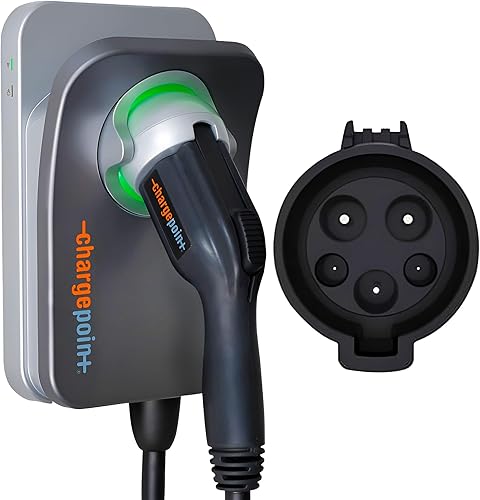
ChargePoint HomeFlex 50A Hardwired Charger: Best for road trips and public charging
- 50A hardwired output, up to 45 miles per hour
- J1772 connector
- ChargePoint app with 274k+ stations
- CarPlay and Android Auto
The HomeFlex pairs a 50A home install with the ChargePoint app, which also finds public stations across North America.
Pros
- 50A hardwired output
- App finds 274k+ public stations
- UL certified and ENERGY STAR
Cons
- Wi-Fi needed for some app features
- Tesla EVs need an adapter
The ChargePoint HomeFlex is the charger to pick if you also want help finding public stations on the road. Its app reaches 274k+ stations across North America and Europe plus 565k+ roaming partners.
At home, the hardwired version charges at up to 50A and about 45 miles per hour. ChargePoint lists UL certification and a cold-resistant cable, and the unit installs indoors or outdoors.
The app handles schedules, reminders and smart-home connections. CarPlay and Android Auto put station info on your dash.
Note that Wi-Fi is needed for some app features and for troubleshooting.
The J1772 plug covers non-Tesla EVs; Tesla owners need an adapter. Against the Autel, it trades some cable-temperature range for the larger public network.
Buy it for a driver who wants one app for home charging and road-trip planning. Skip it if your home Wi-Fi is weak where the charger goes.
Emporia Pro 48A Hardwired Charger: Best for limited electrical panels
- 48A hardwired output
- PowerSmart load balancing
- Includes Emporia Vue monitor
- J1772 connector
PowerSmart balances charger load against your existing panel so you can charge at 48A without a service upgrade.
Pros
- PowerSmart works with your current panel
- Vue monitor shows whole-home energy use
- 3-year warranty
Cons
- Higher cost than the standard Emporia
- Load balancing setup needs an electrician
The Emporia Pro is the pick for older homes with a panel that can't spare a full 48A. Its PowerSmart software works with your existing panel to balance charger load against the rest of the house, so you can charge at the top rate your service allows.
The kit includes an Emporia Vue home energy monitor with two 200A CT sensors. That gives real-time insight into whole-home use, which helps you see what the car draws against everything else.
The app automates schedules and tracks usage.
It charges at 48A hardwired on a J1772 connector and comes with a 25 ft cable. Emporia recommends professional installation and lists a 3-year warranty.
Against the standard Emporia 48A, it costs more and adds the Vue hardware. The payoff is load balancing and whole-home data for panels near their limit.
Buy it for a panel that's close to full, or for a household that wants to watch total energy use. Skip it if your panel already has room and you just want a fast, simple charger.
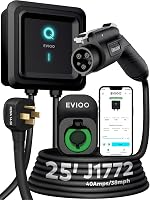
EVIQO 48A Hardwired J1772 Charger: Best for dark garages
- 48A on a 60A circuit, 50A option on 70A
- J1772 connector
- IP66 / NEMA 4 housing
- Glow-in-the-dark holster
The 48A EVIQO adds a glow-in-the-dark holster and app scheduling. DIP switches allow 50A on a 70A circuit.
Pros
- 48A standard, 50A on a 70A circuit
- Glow-in-the-dark holster
- 3-year warranty and US support
Cons
- Requires 2.4 GHz Wi-Fi
- Hardwired install only
EVIQO's 48A hardwired J1772 charger stands out for garage usability. The glow-in-the-dark holster makes the plug easy to find and dock at night, and the 25 ft cable reaches across most garages and driveways.
It runs at 48A on a dedicated 60A, 240V circuit. If you have a 70A circuit, DIP switches 4 and 5 allow 50A.
The free app starts and stops charging, sets speed from 6A to 48A, tracks energy and cost, and schedules off-peak sessions.
EVIQO lists UL, ETL, FCC and ENERGY STAR certification. The IP66 and NEMA 4 housing handles rain, snow, heat and dust, and internal steel shielding protects the electronics.
A 3-year warranty and US-based support back it.
Against the Autel 50A, it needs 2.4 GHz Wi-Fi specifically and gives up the Ethernet option. The holster and DIP-switch speed range are its edge.
Buy it for a dark garage or a driveway where you want easy night docking. Skip it if your home Wi-Fi runs only on 5 GHz.
EVIQO 40A NEMA 14-50 J1772 Charger: Best plug-in alternative
- 40A output on a NEMA 14-50 outlet
- J1772 connector
- 25 ft cable
- IP66 / NEMA 4 housing
The plug-in version of the EVIQO tops out at 40A but skips the hardwire install. It suits renters and garages that already have a 14-50 outlet.
Pros
- No electrician needed for the plug itself
- Same app and weather rating as the 48A model
- 25 ft cable
Cons
- 40A cap versus 48A hardwired
- Needs a dedicated 50A 14-50 outlet
EVIQO's plug-in model belongs here for one reason: it's the practical fallback when hardwiring isn't possible. It runs at 40A on a NEMA 14-50 outlet on a dedicated 50A circuit, so a renter or a home with an existing RV or range outlet can charge without new wiring.
It carries the same app as the 48A EVIQO model, with 6A to 40A speed settings, energy tracking and off-peak scheduling. The IP66 and NEMA 4 housing and glow-in-the-dark holster carry over too.
The 25 ft cable suits most garages. EVIQO lists UL, ETL, FCC and ENERGY STAR certification and a 3-year warranty.
Against the hardwired EVIQO, it gives up 8A of output. That's the price of skipping the electrician.
The outlet must be a dedicated 14-50, not a dryer outlet.
Buy it for a rental or a garage with a spare 14-50 outlet. Skip it if you want the full 48A and can hardwire.
Autel Level 2 Home Smart EV Charger: Best for Tesla owners
- Up to 50A output, about 48 miles per hour
- NACS connector for Tesla
- NEMA 4X rating
- 25 ft cable
A NACS station for Teslas and other NACS-port EVs. It plugs straight into the car's port without an adapter.
Pros
- Built-in NACS plug for Tesla
- 50A output
- NEMA 4X outdoor rating
Cons
- Non-Tesla EVs need an adapter
- Hardwired install by an electrician
The Autel NACS charger is the fit for Teslas and newer EVs with a NACS port. The built-in NACS connector plugs straight into a Tesla charge port with no adapter, which keeps the install simple and the cable count low.
It delivers up to 50A and 12kW, which Autel says adds about 48 miles per charging hour. The NEMA 4X housing is dust-tight and water-tight, and the 25 ft cable stays flexible in cold weather.
The Autel Charge app handles scheduling and off-peak timing over Wi-Fi, Bluetooth or Ethernet. An optional RFID card can stop unauthorized use.
A 3-year warranty covers the unit.
Against the J1772 Autel 50A, it swaps the connector and gains a higher stated miles-per-hour figure. The trade-off is that non-Tesla EVs need an adapter.
Buy it for a Tesla owner who wants a native NACS plug and outdoor-rated hardware. Skip it for a mixed household of non-Tesla EVs.
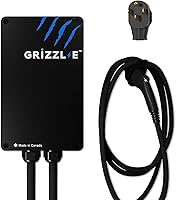
Grizzl-E Ultimate 48A Hardwired Charger: Best for harsh weather
- 48A output, 11.5kW
- J1772 connector
- Cast aluminum NEMA 4X case
- Load balancing across chargers
A cast aluminum station built for tough outdoor conditions. Load balancing shares power across multiple chargers.
Pros
- Heavy-duty NEMA 4X aluminum case
- Load balancing across chargers
- Hardwire kit included
Cons
- Wi-Fi features need the Grizzl-E Connect app
- Premium OCPP access costs extra
Grizzl-E's Ultimate 48A is the pick for exposed installs. Its heavy-duty NEMA 4X cast aluminum enclosure is built to stand up to the harshest weather, and the 25 ft J1772 cable matches that toughness.
It charges at 48A and 11.5kW, which Grizzl-E calls 9x faster than a basic charger. UL and ENERGY STAR certification and a 3-year warranty are included.
The package comes with a mounting bracket and a hardwire kit with terminal lugs and heat shrink.
Grizzl-E Connect software handles real-time monitoring, schedules, energy statistics and diagnostics. Charging works with or without an online connection, and an external antenna helps Wi-Fi reach.
Load balancing shares power across multiple chargers, with equal or priority modes.
Against the Autel 50A, the aluminum case is tougher but the smart features depend on the Grizzl-E app. Premium OCPP access carries a one-time fee.
Buy it for a rural or coastal install where weather is the main worry. Skip it if you want the simplest app-free setup.
EVIQO 48A NACS Hardwired Charger: Best NACS value
- 48A on a 60A circuit
- NACS plug with port-open button
- IP66 / NEMA 4 housing
- Glow-in-the-dark holster
The NACS version of the EVIQO GEN2 adds a plug button that opens a Tesla charge port. It charges at 48A on a 60A circuit.
Pros
- NACS plug with port-open button
- 48A output
- 3-year warranty
Cons
- Needs 2.4 GHz Wi-Fi
- Non-Tesla EVs need an adapter
EVIQO's NACS hardwired charger is the budget route into native Tesla charging. The NACS plug includes a button that pops open a Tesla charge port, so you skip the adapter and the extra hand motion.
It delivers 48A on a dedicated 60A, 240V circuit. DIP switches 4 and 5 allow 50A on a 70A circuit.
The free app handles start and stop, speed from 6A to 48A, reminders, and energy and cost tracking, with off-peak scheduling.
It's certified to UL, ETL, FCC and ENERGY STAR, and the IP66 and NEMA 4 housing covers indoor and outdoor use. The glow-in-the-dark holster and a 3-year warranty round it out.
Against the Autel NACS, it gives up 2A of output and the Ethernet option. In return it brings the port-open button and a lower position on our score board.
Buy it for a Tesla owner who wants native NACS on a tighter budget. Skip it if you want the highest output among the NACS picks.
How we compared these hardwired chargers
We compared these chargers on the specs that decide whether a hardwired install works for you. Output current came first, since 40A, 48A and 50A units need different circuits and deliver different overnight results.
Connector type came second: a J1772 unit covers most non-Tesla EVs, while a NACS unit fits Teslas and newer cars without an adapter.
Weather ratings decided the outdoor picks. We noted NEMA 4, NEMA 4X and IP66 ratings, since a garage install and an exposed driveway install face different conditions.
Smart features came next: app scheduling, off-peak timing, energy tracking and load balancing all affect running costs and setup.
We also weighed certifications like UL and ENERGY STAR, warranty length, and whether a model includes a hardwire kit. Our score weighs specs, features and buyer feedback against what you're shopping for.
| Product | Best for | Amperage | Connector | Weather rating | Our score |
|---|---|---|---|---|---|
| Autel Level 2 EV Charger 50A | most homes | 50 A | J1772 | NEMA 4 | 9.3 |
| Emporia 48A Hardwired J1772 Charger | J1772 EVs | 48 A | J1772 | UL listed | 8.9 |
| ChargePoint HomeFlex 50A Hardwired Charger | road trips and public charging | 50 A | J1772 | 8.8 | |
| Emporia Pro 48A Hardwired Charger | limited electrical panels | 48 A | J1772 | 8.5 | |
| EVIQO 48A Hardwired J1772 Charger | dark garages | 48 A | J1772 | IP66 / NEMA 4 | 8.4 |
| EVIQO 40A NEMA 14-50 J1772 Charger | plug-in alternative | 40 A | J1772 | 8.3 | |
| Autel Level 2 Home Smart EV Charger | Tesla owners | 50 A | NACS | NEMA 4X | 8.1 |
| Grizzl-E Ultimate 48A Hardwired Charger | harsh weather | 48 A | J1772 | NEMA 4X | 8.1 |
| EVIQO 48A NACS Hardwired Charger | NACS value | 48 A | NACS | IP66 / NEMA 4 | 7.8 |
What should you check before buying a hardwired EV charger?
Start with three things: your car's charge port, your electrical panel, and where the charger will sit. Those three answers narrow nine models down to two or three.
Which connector does your car use?
Check the port on the car. Teslas and many newer EVs use NACS.
Most non-Tesla EVs built before 2025 use J1772. A J1772 charger plus the adapter that came with a Tesla works, but a native NACS unit avoids the adapter entirely.
For a broader look at connector and feature choices, read how to choose a smart EV charger.
How much current can your panel spare?
A 48A charger needs a dedicated 60A, 240V circuit. A 50A unit needs 60A or more.
If your panel is close to full, the Emporia Pro's PowerSmart load balancing lets you charge without a service upgrade. Have an electrician do a load calculation before you buy anything.
Does the charger's weather rating match where it goes?
NEMA 4, NEMA 4X and IP66 ratings all cover rain and snow. NEMA 4X adds corrosion resistance for coastal air.
An indoor garage needs less, but a unit rated for outdoor use gives you flexibility if you move it later. Check the cable's cold rating too if you live somewhere with hard winters.
How fast do you actually need to charge?
Work backward from your daily drive. A 40A unit adds roughly 30 miles per hour, while 48A to 50A units add 37 to 48.
If you drive 40 miles a day and charge overnight, even 40A is plenty. The faster units pay off for long commutes or two-EV households.
Which hardwired charger suits a Tesla?
The Autel NACS charger is the best fit for a Tesla, because its built-in NACS plug needs no adapter. The EVIQO 48A NACS charger is the value alternative, and its plug has a button to open the charge port.
Both charge at up to 48A to 50A. The Autel gives up 2A to the EVIQO in the other direction: the NACS EVIQO tops out at 48A on a 60A circuit.
Compare the two in our 48 amp EV charger guide if you're weighing 48A models across connector types.
If you already own a J1772 charger or want one charger for a mixed household, a J1772 unit plus a Tesla adapter keeps your options open. Otherwise, native NACS is the simpler install.
When is a 40A charger the better buy?
A 40A charger is the better buy when your panel, your outlet or your driving habits cap you below 48A. It adds about 30 miles per hour, which covers most overnight charging needs.
The EVIQO 40A NEMA 14-50 model here skips hardwiring entirely. If your garage already has a dedicated 14-50 outlet, you avoid the electrician visit and the panel check.
That's the main reason to drop to 40A.
Go 40A if your daily drive is under 60 miles and your car's onboard charger accepts 40A or less anyway. Many EVs cap what they can take, so a 50A station won't always charge faster than a 40A one.
Our 40 amp EV charger guide covers the models that fit that circuit.
Should you pick a hardwired or plug-in charger?
Hardwired is the right call for a permanent home install. It allows 48A to 50A output, avoids some GFCI nuisance trips on older panels, and gives a cleaner, more secure install.
Plug-in suits renters and homes with an existing 14-50 outlet.
The 8A gap matters less than it sounds. A 40A unit adds about 30 miles per hour and a 48A unit about 37 to 46.
If you sleep 8 hours and drive 40 miles a day, both refill your car with room to spare.
The bigger difference is the panel. A hardwired 48A charger needs a 60A circuit and a load calculation.
If your panel can't take it, a plug-in on a 14-50 outlet or a load-balancing hardwired unit like the Emporia Pro solves the problem without a service upgrade. For a full comparison of charger types and features, see our EV charger for home guide.
What smart features are worth paying for?
Scheduling and energy tracking are the two smart features worth paying for. They let you charge in off-peak hours and see what the car costs you each month.
Load balancing is worth it only if your panel is tight.
Scheduling: every app-controlled model here offers it. Emporia says off-peak scheduling can cut energy costs by 30 percent.
Set the session to start after your utility's peak window ends and the car finishes before you leave.
Energy tracking: the Emporia, EVIQO, ChargePoint and Autel apps all report energy use and cost. The Emporia Pro adds the Vue monitor for whole-home data.
That's useful if you want to see how the car compares with the rest of your load.
Load balancing: only the Emporia Pro and Grizzl-E Ultimate list it. It shares power between chargers or between the charger and the house.
If your panel has room, skip it and save the cost.
Network access: ChargePoint's app finds public stations on the road. That's a bonus, not a charging need.
Buy for the home features first.
Verdict: which hardwired EV charger should you buy?
The best hardwired EV charger for home for most people is the Autel Level 2 EV Charger 50A. It pairs 50A output with a NEMA 4 outdoor rating, a 25 ft cold-rated cable and app scheduling, and its 3-year warranty matches the field.
Pick by your situation. Choose the Emporia 48A Hardwired J1772 for a non-Tesla EV and its energy data in the app.
Go with the Emporia Pro if your panel is close to full. Pick the ChargePoint HomeFlex if you want one app for home and public charging.
For a Tesla, the Autel NACS charger is the native fit and the EVIQO NACS is the value pick. If you're still mapping charger types against your car, start with our EV charger for home guide.
Our top 3 picks at a glance
-
1
-
2
-
3
Best for road trips and public charging
ChargePoint HomeFlex 50A Hardwired Charger
8.8/10 our score
See it on Amazon
Frequently asked questions
Is a hardwired EV charger better than a plug-in model?
Hardwiring lets a Level 2 charger run at up to 48A or 50A, while most plug-in models cap at 40A on a NEMA 14-50 outlet. Hardwiring also avoids nuisance GFCI trips on some panels.
Pick hardwired for the fastest home charging and plug-in for portability or rental homes.
What circuit size does a hardwired EV charger need?
A 48A charger needs a dedicated 60A, 240V circuit. A 50A unit needs a 60A or larger circuit.
Some models offer 50A on a dedicated 70A circuit.
Have a licensed electrician check your panel capacity first.
Do hardwired EV chargers work with Teslas?
Only if you choose a NACS model or use a J1772-to-NACS adapter. J1772 stations cover most non-Tesla EVs.
The Autel NACS and EVIQO NACS chargers here plug straight into a Tesla port with no adapter.
Can a hardwired EV charger go outside?
Yes, if its weather rating says so. Look for NEMA 4, NEMA 4X or IP66.
Those ratings cover rain, snow and splashing water.
An electrician should mount it at a height that keeps the cable off the ground.
How many miles per hour does a hardwired Level 2 charger add?
A 48A to 50A hardwired station adds roughly 37 to 48 miles per hour, depending on the car. The Autel 50A model says 37 miles per hour and the NACS version says 48.
Your car's onboard charger limits what it can accept.
Does a smart hardwired charger cut electricity costs?
It can if you schedule charging in off-peak hours. Emporia and EVIQO apps both offer scheduled sessions.
Emporia says off-peak scheduling can cut energy costs by 30 percent.