How Much Power Does a Level 2 EV Charger Use?
A Level 2 EV charger uses about 7.2 to 9.6 kW at 240V, depending on its amperage setting. A 32A unit draws roughly 7.68 kW and a 40A unit draws about 9.6 kW, so a typical overnight charge uses 50 to 80 kWh of electricity.
On this page (9 sections)
- How much power does a Level 2 EV charger use in kilowatts?
- What is the difference between kW and kWh?
- How many kWh does a full charge actually need?
- How does amperage set the power a charger uses?
- Why does the breaker matter more than the charger's rating?
- How much does Level 2 charging add to your electric bill?
- How do you match charger power to your home and your driving?
- What should you know about sharing a circuit or using a portable unit?
- What's the short answer on Level 2 power use?
A Level 2 EV charger uses about 7.2 to 9.6 kW at 240V, depending on its amperage setting. A 32A unit draws roughly 7.68 kW and a 40A unit draws about 9.6 kW, so the power a Level 2 EV charger uses lands in the same range as an electric oven or a clothes dryer.
The number matters because it sets both your charge speed and the circuit the charger needs. Here's how the amps translate into kilowatts and kWh, and how to pick a setting that fits your home.
How much power does a Level 2 EV charger use in kilowatts?
A home Level 2 charger delivers 3.8 to 11.5 kW, with the most common models sitting at 7.2 to 9.6 kW. The formula is simple: amps times volts equals watts.
At 240V, each 10A of current is about 2.4 kW.
The table below shows the standard settings you'll meet in product listings and on charger dials.
| Amperage | Power at 240V | Typical breaker |
|---|---|---|
| 16A | 3.84 kW | 20A |
| 24A | 5.76 kW | 30A |
| 32A | 7.68 kW | 40A |
| 40A | 9.6 kW | 50A |
| 48A | 11.5 kW | 60A |
Most plug-in home chargers stop at 40A because that's the limit of a NEMA 14-50 outlet on a 50A circuit. A 48A unit has to be hardwired.
So if you see a Level 2 charger sold with a 14-50 plug, expect 9.6 kW as its top output.
What is the difference between kW and kWh?
kW is the rate of power and kWh is the amount used over time. A 7.68 kW charger running for one hour uses 7.68 kWh.
Run it for three hours and you've added about 23 kWh to the car.
This matters when you compare a fast charger with a slow one. The kW tells you how quickly energy flows.
The kWh tells you what shows up on your electric bill. A bigger kW rating just means the same energy arrives sooner.
Think of it like water. kW is the width of the pipe and kWh is the water that lands in the bucket. A wider pipe fills the bucket faster, but the bucket size doesn't change.
How many kWh does a full charge actually need?
A typical EV needs about 50 to 70 kWh from the wall for a full charge, though the exact figure depends on battery size and charging losses. Charging isn't perfectly efficient; about 10% to 15% is lost as heat in the charger and the car's onboard equipment.
A car with a 60 kWh battery will pull roughly 65 to 70 kWh from the outlet. A larger 100 kWh pack needs closer to 110 kWh.
Your charger's kW rating only sets how long that takes, not how much energy it takes.
For a 32A charger at 7.68 kW, a 65 kWh fill takes about 8.5 hours. A 40A charger at 9.6 kW does the same job in about 7 hours.
That's the real-world difference between the two settings.
How does amperage set the power a charger uses?
The amps you select on the charger are the main control on power draw. The voltage stays at 240V in a home setup, so dialing the current down cuts the kilowatts in a straight line.
Many Level 2 chargers let you pick from several settings. The EVDANCE 32A Portable Level 2 Charger offers 16A, 24A and 32A, which works out to 3.84 kW, 5.76 kW and 7.68 kW.
It's a 32A unit that you can slow down when the circuit or the battery calls for it.
The 25 ft cable and the carrying case make it easy to move between a garage and a covered driveway. Its LED screen shows the current setting and the charging speed as it runs.
If you rent or move often, a charger you can unplug and take with you avoids leaving an install behind. Compare more of them in our guide to the best portable Level 2 EV chargers.
Why does the breaker matter more than the charger's rating?
A Level 2 circuit must be sized about 25% above the charger's output. That headroom is a safety rule, not a suggestion.
The breaker protects the wiring, so a charger running at 40A needs a 50A breaker and wire rated for it.
This is why you see 32A chargers paired with 40A breakers and 40A chargers paired with 50A breakers. Run a 40A charger on a 40A breaker and it will trip under continuous load.
The charger's own settings should match the circuit, not the other way around.
If your garage only has a 30A circuit, set the charger to 24A. A 20A circuit gets 16A.
Most modern units offer those lower steps precisely so a household can charge without a panel upgrade.
How much does Level 2 charging add to your electric bill?
Expect about 50 to 80 kWh for a typical weekly charge, which is the biggest number in this whole calculation. At a national average electricity rate near 17 cents per kWh, that's roughly 8 to 14 dollars a week for most drivers.
The exact figure depends on your rate and how much you drive. Off-peak or time-of-use plans can cut the cost.
That's why scheduled charging is worth using: several chargers let you set a start time so the car fills overnight when power is cheapest.
The EVIQO 40A NEMA 14-50 J1772 Charger supports speed settings from 6A to 40A and app-based scheduling. That range gives you a slow top-up or a full 9.6 kW session when you need one.
It needs a 240V NEMA 14-50 outlet on a dedicated 50A circuit. If your outlet is the RV or range type, that's the right match.
A dryer outlet won't fit without an adapter, and the charger is clear on that point. For cost comparisons across models, see how much does a Level 2 charger cost.
How do you match charger power to your home and your driving?
Start with your daily miles, then work backward to amps. Most drivers cover 30 to 40 miles a day, which is 8 to 12 kWh.
A 32A charger replaces that in about 1.5 to 2 hours.
A 16A setting takes three to four hours.
So the biggest kW rating is rarely necessary. A 40A unit suits a household with two EVs, a large battery, or a short overnight window.
A 32A or 24A setting covers most single-car homes comfortably.
Check three things before you buy: the outlet type in your garage, the breaker size on that circuit, and the charging window you actually have. If you're unsure what circuit you have, a licensed electrician can confirm it in a short visit.
Our guide to choosing an EV charger for home walks through outlet types in more detail.
What should you know about sharing a circuit or using a portable unit?
A Level 2 charger should have its own dedicated circuit. Sharing an outlet with a dryer or welder means the breaker can trip, or worse, the circuit can overheat when both run at once.
Some smart chargers include load management so they dial back when another appliance is on. If you need that, confirm it's built in before you buy.
Otherwise, keep the charger on its own breaker.
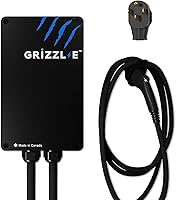
A portable unit like the Grizzl-E Level 2 240V / 40A Electric runs at 40A, 32A, 24A or 16A and plugs into a NEMA 14-50 outlet. Its adjustable amperage makes it a fit for garages where the circuit size varies from one home to the next.
Grizzl-E says the 40A setting adds 28 to 30 miles of range per hour, while 16A adds 10 to 12. That spread shows how much the setting changes the real-world result.
It's UL listed and rated IP67, so it handles covered outdoor parking as well as an indoor wall. The 24 ft cable reaches across most garages.
If more than one person uses the charger, our guide to whether anyone can use my home EV charger covers access and safety. A shared unit on a dedicated circuit still needs the amps set to match the breaker.
What's the short answer on Level 2 power use?
A Level 2 charger uses 7.2 to 9.6 kW while charging, and the power a Level 2 EV charger uses is set by its amperage. Pick a 32A model on a 40A breaker for most homes, or a 40A model on a 50A circuit if you have a big battery or a short overnight window.
The EVDANCE 32A is the practical pick for renters and smaller circuits, thanks to its 16A to 32A steps. The EVIQO 40A suits drivers who want app scheduling and the full 9.6 kW.
The Grizzl-E 40A fits garages where the circuit size varies or the unit will sit outdoors under cover.
Whichever you choose, set the amps to match the breaker and let the car charge overnight. That keeps the load safe and usually puts the energy use in the cheapest rate window.
If you're still deciding on a model, start with our EV charger for home picks before you book an electrician.
Frequently asked questions
How many amps does a Level 2 EV charger use?
Most home Level 2 chargers draw 16A to 48A. The charger's amp rating is its output, and the breaker is usually sized about 25% higher, so a 32A charger needs a 40A breaker.
Does a Level 2 EV charger use power when the car is not charging?
A plugged-in Level 2 unit draws a small standby amount for its screen, Wi-Fi and safety checks. That is a few watts, not kilowatts, so it adds little to a monthly bill compared with the charging sessions.
What is the difference between 7.68 kW and 9.6 kW Level 2 charging?
The difference is the current. A 32A charger delivers 7.68 kW and a 40A charger delivers 9.6 kW at 240V.
The 40A unit adds about 2 kW, which charges a large battery faster but needs a 50A circuit.
Can a Level 2 EV charger overload a house?
Not if the circuit is dedicated and the breaker matches the load. A 32A charger on a 40A breaker or a 40A charger on a 50A breaker sits inside the safe limit.
Share an existing circuit without a load manager and the risk rises.
How many kWh does it take to charge an EV at home?
It depends on the battery. A typical 60 to 75 kWh pack needs roughly 50 to 70 kWh from the wall once charging losses are counted.
A 40A charger replaces about 40 kWh in four hours.