Are All Home EV Chargers the Same?
No, home EV chargers are not the same. They differ in how much current they deliver, whether they plug in or hardwire, which connector they use and what smart features they add.
On this page (7 sections)
- What actually differs between home EV chargers?
- Does a higher amp rating always mean faster charging?
- Is a plug-in or hardwired charger the better choice?
- Do all home chargers use the same connector?
- What do smart features add to a home charger?
- Which amperage fits a typical home setup?
- Which home EV charger should you pick?
No, home EV chargers are not the same. They differ in how much current they deliver, whether they plug in or hardwire, which connector they use and what smart features they add.
Two chargers that look alike can charge at different speeds, fit different outlets and suit different cars.
The word "charger" hides a lot. What you buy is a box that supplies AC power to the charger built into your car.
The differences between models come down to a handful of specs you can compare before you spend anything.
What actually differs between home EV chargers?
The main differences are amperage, installation type, connector and smart features. Everything else is detail around those four.
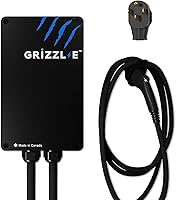
Amperage sets the ceiling on charging speed. A 40A Grizzl-E Classic adds roughly 28 to 30 miles of range per hour, while a 32A setting on the same unit drops to about 22 to 25 miles per hour.
A 50A hardwired unit like the ChargePoint HomeFlex goes higher, and ChargePoint says it adds up to 45 mi/hr depending on the vehicle.
Installation type decides how the unit gets power. Plug-in models use a 240V outlet, while hardwired models connect straight to the panel.
Connector type decides which cars fit without an adapter. Smart features decide whether you can schedule charging and track energy from an app.
The same physical box can also be sold in several versions. The ChargePoint HomeFlex comes as hardwired or as NEMA 6-50 and 14-50 plug models, and the plug versions top out at 40A.
If you want the fastest charge, the version you buy matters as much as the brand.
Does a higher amp rating always mean faster charging?
No. Your car's onboard charger caps how much current it accepts, so a 50A unit won't beat a 40A one on a car limited to 40A.
Think of the charger as a tap and the car as the bucket. Opening the tap wider only helps if the bucket can take the flow.
Many mainstream EVs accept 32A to 48A, so a 40A charger already maxes out a lot of cars.
That's why matching matters more than chasing the biggest number. If your car accepts 48A and your panel supports an 80A circuit, a 50A hardwired unit gives you the full speed.
If your car tops out at 40A, a 40A plug-in model does the same job for less installation work.
The circuit breaker is the other ceiling. Grizzl-E sets its Classic to 40A on a 50A breaker, 32A on a 40A breaker, 24A on a 30A breaker and 16A on a 20A breaker.
A charger can only draw what the circuit safely allows.
Is a plug-in or hardwired charger the better choice?
Plug-in is easier and hardwired is faster. Pick the one that matches your outlet situation and how much speed you want.
A plug-in charger needs a dedicated 240V outlet. The Grizzl-E Classic uses a NEMA 14-50 plug and a 24 ft cable.
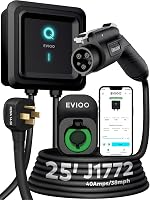
The EVIQO also uses a NEMA 14-50 plug, with a 25 ft cable. Both let you install the outlet once and swap or move the charger later.
EVIQO says its plug needs the RV or range style NEMA 14-50 outlet, not a dryer outlet.
Hardwiring skips the outlet and connects the unit directly to the panel. That's how you reach 50A and beyond.
The ChargePoint HomeFlex hardwired version is rated for a 20A or 80A circuit and delivers up to 50A. For a deeper look at the category, see our roundup of the best hardwired EV chargers for home.
Hardwiring costs more up front because an electrician has to run the circuit. It pays back in speed and a cleaner install with no outlet to wear out.
Plug-in suits renters and anyone who already has the right outlet.
Do all home chargers use the same connector?
No. J1772 and NACS are the two main connectors, and your car's port decides which one you need.
J1772 is the round connector used on most non-Tesla EVs and plug-in hybrids sold before 2025. The EVIQO uses a standard J1772 connector and plugs straight into Ford, Chevrolet, Hyundai, Kia, Nissan, BMW, Volkswagen and other J1772 cars without an adapter.
Tesla drivers can use a J1772 charger with the adapter that comes with the car.
NACS is the connector Tesla uses and many new EVs from 2025 adopt. A NACS car needs either a NACS charger or a J1772 unit plus an adapter.
ChargePoint notes that its J1772 HomeFlex needs an adapter for Tesla vehicles.
So when you ask are all home ev chargers the same on the plug front, the answer is no. A charger with the wrong connector is the wrong charger, even if every other spec lines up.
Check your owner's manual, as ChargePoint advises, before you order.
What do smart features add to a home charger?
Smart features add scheduling, energy tracking and remote control. They don't change how much power flows, but they change how you use it.
The EVIQO pairs with a free app over 2.4 GHz WiFi. You can start and stop charging, set speed from 6A to 40A, get reminders and track energy use and cost.
Scheduling off-peak overnight charging is the feature that saves real money for many drivers. A side reset button restarts the unit in seconds without shutting off power at the breaker, and over-the-air updates keep it current.
The ChargePoint HomeFlex works with the ChargePoint app, which handles control, reminders, smart home connections, station finding and charging data. ChargePoint also runs a network of 274k+ stations across North America and Europe.
Its app also supports widgets for finding nearby stations and Apple CarPlay and Android Auto integration.
A basic charger without WiFi still charges your car. It just can't schedule, report or update.
If your utility offers off-peak rates or you want a record of home charging costs, smart features are worth having.
Which amperage fits a typical home setup?
40A is the practical default for most garages. It charges a typical EV overnight and fits a standard 50A circuit.
A Grizzl-E Classic at 40A adds roughly 28 to 30 miles per hour, which covers most daily driving in a couple of hours. The EVIQO delivers up to 40A and, per EVIQO, fully charges most EVs overnight.
For a shortlist of these units, see our guide to the best 40 amp EV chargers.
Step up to 48A or 50A when your car accepts it and your panel can spare the capacity. The ChargePoint HomeFlex hardwired reaches 50A and, ChargePoint says, charges 9 times faster than a 120V outlet.
That speed helps with long commutes and two-EV households.
Before buying either, have an electrician check the panel. A 50A circuit needs two open breaker slots and enough service capacity.
A hardwired 50A unit needs an 80A circuit per ChargePoint. ChargePoint recommends hiring a licensed electrician for its hardwired install.
Which home EV charger should you pick?
Pick a 40A plug-in charger for most garages, and a 50A hardwired unit when your car and panel allow it. The three units here cover those cases.
The Grizzl-E Classic is the pick for most people. It runs 40A on a NEMA 14-50 outlet, has four amperage settings for smaller breakers, a 24 ft cable and an IP67 metal case rated for indoor and outdoor use.
It is UL full tested and certified and eligible for federal rebate programs. Its score of 9 leads this group.
The EVIQO is the choice when you want app control at 40A. Its J1772 connector fits every non-Tesla EV, the 25 ft cable reaches across a garage, and the app handles scheduling and energy tracking.
It carries UL, ETL, FCC and Energy Star certification, a sealed IP66 housing and a glow-in-the-dark holster. It scores 8.3.
The ChargePoint HomeFlex hardwired is the fastest option here. At up to 50A on a hardwired circuit, it adds up to 45 mi/hr per ChargePoint, with app control, a 23 ft cold-resistant cable and UL certification.
It scores 8.8. Our roundup of the best 48 amp EV chargers covers the units just above this tier.
If you're still deciding overall, start with our best EV chargers for home guide. So are all home ev chargers the same?
No, but once you match amperage, installation type and connector to your car and panel, the shortlist gets small fast. Check your car's onboard charger limit and your panel capacity first, then buy the charger that fits both.
Frequently asked questions
Are all home EV chargers the same?
No. Home EV chargers vary in amperage, plug versus hardwired installation, connector type and smart app features.
A 40A plug-in unit and a 50A hardwired unit charge at different speeds and fit different garages.
Does a higher amp charger always charge faster?
Not always. Your car's onboard charger caps how much current it accepts, so a 50A unit may not beat a 40A one on a vehicle limited to 40A.
Match the charger to the car and the circuit.
Can I plug any home EV charger into a regular outlet?
No. Level 2 chargers need a 240V circuit.
A NEMA 14-50 plug model needs a dedicated 50A circuit, while a hardwired model needs an electrician to wire it directly to the panel.
Do I need an electrician to install a home EV charger?
For a hardwired unit, yes. A plug-in model can use an existing 240V outlet, but the circuit must be dedicated and rated for the charger's draw.
A licensed electrician should confirm your panel can handle it.
Which home EV charger is best for most garages?
A 40A plug-in model like the Grizzl-E Classic is a practical starting point when you already have or can add a NEMA 14-50 outlet. Pick a 50A hardwired unit like the ChargePoint HomeFlex when you want the fastest charge your car allows.