Are Home EV Chargers AC or DC?
Home EV chargers are AC. A wall unit or portable cable feeds alternating current from your home's electrical supply into the car, and the vehicle's built-in onboard charger converts it to DC before it reaches the battery.
On this page (7 sections)
- What kind of power does a home EV charger actually supply?
- Why does the DC conversion happen inside the car?
- How are AC home chargers different from DC fast chargers?
- What are Level 1 and Level 2 in AC terms?
- How fast will an AC home charger fill my car?
- Can a home charger convert AC to DC itself?
- What does this mean for choosing a home charger?
Home EV chargers are AC. A wall unit or portable cable sends alternating current from your home's wiring into the car, and the vehicle's own onboard charger flips it to DC before the energy goes into the battery.
That single detail explains why home charging speeds differ so much between cars, even when they use the same charger.
So when people ask are home ev chargers ac or dc, the short version is that the charger is AC and the conversion happens inside the vehicle. The wall box is really a safe, smart switch that negotiates power with the car.
The car does the hard electrical work.
What kind of power does a home EV charger actually supply?
A home charger supplies AC power only. Every Level 1 cable and Level 2 wall unit sold for residential use feeds alternating current to the vehicle, and none of them convert it to DC themselves.
The charger's job is to deliver a controlled AC current at a safe voltage. Level 1 runs on a standard 120V outlet.
Level 2 runs on a 240V circuit, which is why it charges faster.
The car's onboard charger sits between the inlet and the battery. It rectifies the AC into DC and regulates it for the pack.
That is the step that makes home charging possible on ordinary household power.
The charger also has to tell the car how much current is safe to draw. It does that over the same cable, using a pilot signal that varies with the circuit size.
The car reads that signal and never pulls more than the circuit allows. This is why the amperage settings on a charger matter so much, and why a unit with selectable current is more flexible across homes.
Why does the DC conversion happen inside the car?
Because the battery can only store DC. Lithium-ion packs charge with direct current, so anything coming in as AC has to be converted first.
Automakers build that converter into the car so any AC source can charge it.
This is also why the onboard charger rating matters so much. A car with a 7.2 kW onboard charger will never pull more than about 7.2 kW, no matter how large the wall unit is.
A car rated at 11 kW can use a bigger charger and finish sooner.
The onboard charger also handles the charging curve. It slows the flow as the pack fills, which protects battery health and is why the last few percent take longer.
Keeping the converter in the car also means the same hardware works at home and on the road. A car can plug into a garage unit, a friend's 120V outlet or a public AC station and rely on its own converter each time.
The external hardware only has to supply clean, safe AC and report how much current is available.
How are AC home chargers different from DC fast chargers?
DC fast chargers skip the car's converter. A public fast charger converts AC to DC in the station itself and sends DC straight to the battery, which is why it can deliver far more power than a home unit.
That is the key split. Your garage unit tops out at the onboard charger's limit, often between 7 kW and 11.5 kW.
A DC fast charger can push 50 kW or far more because the heavy conversion hardware lives in the station, not the car.
Home hardware is smaller, cheaper and easier to install for exactly that reason. The trade-off is speed.
DC stations exist to get you moving on a trip, while home AC charging is designed to refill the car overnight.
What are Level 1 and Level 2 in AC terms?
Both are AC, and the level only describes the voltage and speed. Level 1 uses a 120V household outlet.
Level 2 uses a 240V circuit, like the one behind an electric dryer or range.
Level 1 is the slowest option. It's fine for plug-in hybrids and low-mileage drivers who leave the car parked for long stretches.
Level 2 is the everyday standard for full EVs and adds meaningful range per hour.
The naming can confuse people, since neither level says anything about AC versus DC. The real divide is AC at home versus DC at public fast-charging sites.
Level 2 units also tend to be the ones with fixed or selectable amperage settings. That is what lets a single model fit a 20A, 30A, 40A or 50A breaker by dialing the current to match.
A Level 1 cable, by contrast, is built around one ordinary outlet and one current level.
How fast will an AC home charger fill my car?
Speed depends on the lowest of three limits: the circuit breaker, the charger's output and the car's onboard charger. The slowest link sets the pace, so a bigger wall unit only helps if the car and wiring can use it.
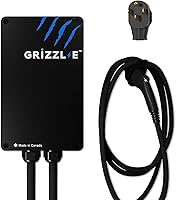
Grizzl-E says the Classic's 40A setting adds 28 to 30 miles of range per hour on a 50A breaker. At 32A on a 40A breaker it drops to 22 to 25 miles per hour, and at 16A on a 20A breaker it adds 10 to 12 miles per hour.
Those figures assume a car that can accept the full current. At 24A on a 30A breaker the rate lands between those two at 15 to 18 miles per hour.
For most drivers, overnight is enough. If you commute 30 to 40 miles a day, a 40A Level 2 setup refills that in a couple of hours.
Our guide to the best EV chargers for home use compares the main options by speed and install type.
When does a bigger AC charger actually help?
A larger charger helps when your car's onboard charger and your home's circuit can both support it. If either one caps out lower, the extra capacity goes unused.
Check your car's onboard charger rating before you buy. Then check the circuit you plan to use.
A 48A unit needs a 60A breaker, while a 40A unit needs a 50A breaker. If your panel has no room for the larger circuit, the smaller charger is the sensible pick.
Compare the best 40 amp EV chargers and the best 48 amp EV chargers if you are deciding between those two circuit sizes. If you want a fixed installation without an outlet, the best hardwired EV charger for home roundup covers the wiring differences.
What about Level 1 AC charging?
Level 1 stays on AC and simply uses a normal wall outlet. It is the cheapest way to start, and it works well for plug-in hybrids or anyone who drives only a few miles a day.
The Lectron unit runs on 120V at 15A and puts out up to 1.65 kW. It adds roughly 40 to 50 miles over an overnight session, which covers many short commutes.
It plugs into a standard NEMA 5-15 outlet and needs no hardwiring. The cable runs 16 feet, so you can reach a parking spot without moving the car, and the unit is rated IP65 for dust and water resistance.
It works with J1772 vehicles. Tesla owners need a J1772-to-Tesla adapter.
Keep in mind that Level 1 is slow by design, so it suits topping up rather than fully refilling a large battery every night.
Can a home charger convert AC to DC itself?
No, and that is by design. A residential charger is an EVSE, or electric vehicle supply equipment.
It handles safety, communication and current control, then hands AC to the car.
Building a converter into every wall unit would make home chargers heavier, pricier and harder to install. Automakers already put one in the car, so the wall box doesn't need its own.
That keeps home hardware affordable and keeps the conversion where the battery management system can supervise it.
The charger still does important work. It checks the connection, grounds the circuit, signals the available current and stops the flow if something goes wrong.
Grizzl-E lists protections like ground fault and over temperature detection on the Classic, and the Ultimate is UL and Energy Star certified.
The Classic also has a built in GFCI and self-monitoring that recovers after a power outage. Those features exist because the wall unit is the first line of safety on an AC connection.
The DC conversion and battery-level protection happen later, inside the car.
What does this mean for choosing a home charger?
Buy an AC charger that matches your car and your electrical panel. The AC versus DC question doesn't change your shopping list, since every home unit is AC.
What matters is the current it can deliver and the circuit it needs.
Start with your car's onboard charger rating. Then look at your panel capacity and whether you want a plug-in or hardwired install.
A 40A plug-in unit is the easy choice when you already have a 14-50 outlet. A 48A hardwired model makes sense when you are running a new circuit and your car can take the current.
The answer to are home ev chargers ac or dc shapes the rest of your setup. Your home unit supplies AC, your car converts it, and the slowest link in that chain sets your real charging speed.
Pick a charger that fits that chain rather than one that overshoots it, and the install stays simpler and the cost lower.
Frequently asked questions
Is a DC fast charger the same as a home charger?
No. DC fast chargers are commercial units that skip the car's onboard converter and feed power straight to the battery.
A home unit sends AC, so the car's onboard charger sets the real charging speed.
Does a home charger's amperage decide how fast my car charges?
Partly. The charger's output is only one limit; your car's onboard charger rating and the circuit's breaker size also cap the speed.
The lowest of those three wins.
Can I install a Level 2 home charger myself?
A plug-in model on an existing 240V outlet is a swap. A hardwired unit needs a new circuit, a permit and a qualified electrician in most areas, so plan for that cost before you buy.
Why does my car charge slower than the charger's rating?
Your vehicle's onboard charger is likely the bottleneck. Many cars accept less than the wall unit can deliver, so the car pulls only what its converter allows.
Do I need a DC charger at home for daily driving?
No. Nearly all daily charging happens on AC, either overnight on a Level 2 unit or slowly on a Level 1 cable.
DC fast chargers are for road trips and top-ups away from home.