Types of Home EV Chargers Explained
Home EV charging comes in three practical types: Level 1 runs on a standard 120V outlet, Level 2 plug-in uses a 240V outlet you already have or can add, and Level 2 hardwired connects straight to a dedicated circuit. Level 2 hardwired is the fastest; Level 1 is the simplest.
On this page (10 sections)
- What are the different types of home EV chargers?
- How does Level 1 charging work?
- What does a Level 2 plug-in charger need?
- When should you choose a hardwired Level 2 charger?
- Which type of home EV charger is fastest?
- What wiring does each charger type need?
- Which type fits your driving habits?
- Can you mix charger types at home?
- How we chose these chargers
- Which home EV charger type should you pick?
Home EV charging comes in three practical types: Level 1 on a standard 120V outlet, Level 2 plug-in on a 240V outlet, and Level 2 hardwired straight to a dedicated circuit. Level 2 hardwired is the fastest; Level 1 is the simplest to start with.
Choosing among the different types of home EV chargers mostly depends on how far you drive and what wiring your garage already has. A short commute can live on a 120V wall socket.
A long one usually pushes you toward a 240V circuit.
The rest of this guide walks through each type in turn, shows what each one needs from your electrical panel, and names the product we would pick for each setup.
What are the different types of home EV chargers?
There are three main types: Level 1, Level 2 plug-in and Level 2 hardwired. They differ in voltage, connector and how they draw power, not in whether they can charge your car.
The type you pick sets your charging speed. Each step up moves more power through the charger and shortens the overnight charge.
The two broad levels are Level 1 and Level 2. Level 1 runs on household 120V current and is the slowest.
Level 2 runs on 240V, the same voltage your dryer or oven uses, and splits again by how it connects.
That split matters because plug-in and hardwired Level 2 chargers draw different amounts of current. A plug-in unit on a NEMA 14-50 outlet tops out at 40A in the models here.
A hardwired unit can reach 48A on a dedicated 60A circuit.
Every type charges through a J1772 or NACS connector, depending on your car. Tesla vehicles use NACS and need an adapter for a J1772 charger unless the car came with one.
The comparison below groups the three types by what they need and how fast they top up.
| Type | Voltage | Typical current | Connects to |
|---|---|---|---|
| Level 1 | 120V | 15A | Standard NEMA 5-15 outlet |
| Level 2 plug-in | 240V | Up to 40A | NEMA 14-50 outlet |
| Level 2 hardwired | 240V | Up to 48A | Dedicated 60A circuit |
Start with the outlet you have, then move up only when your daily miles outgrow it.
How does Level 1 charging work?
Level 1 is the simplest type: it plugs into a standard 120V wall outlet and needs no electrician. It is slow, which makes it a fit for light use rather than heavy commuting.
A Level 1 charger adds only a trickle each hour, so it works best overnight and with a short daily drive.
The Lectron Level 1 Charger is a good example of this type. It draws 15A at 120V, plugs into a NEMA 5-15 outlet, and comes with a 16 ft cable so you can reach across a driveway.
Because it needs no hardwiring, it is the pick for a renter or anyone who moves. You can carry it to a friend's house or a rental and charge from the wall.
The trade-off is speed. A Level 1 session adds mileage slowly, so a car with a large battery may not finish a full charge in one night.
That limit makes this type a fit for a second car, a plug-in hybrid, or a driver who covers only a few miles a day.
The Lectron charger is ETL certified to the UL2594 standard and IP65 rated for dust and water. It only works with EVs that use the J1772 connector; Tesla drivers need a J1772-to-Tesla adapter.
Pick Level 1 when the wiring is the blocker, not the drive.
What does a Level 2 plug-in charger need?
A Level 2 plug-in charger needs a 240V outlet, usually a NEMA 14-50, and charges far faster than Level 1. It is the middle option: fast enough for daily driving and easy to unplug if you move.
This type leans on an outlet your garage may already have, so installation can be as simple as plugging in.
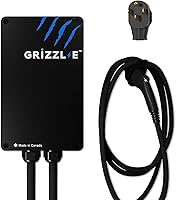
The Grizzl-E Classic is the pick here. It has a NEMA 14-50 plug and a 24 ft cable, and it can be set to 40A, 32A, 24A or 16A depending on the breaker behind the outlet.
That amperage switch matters for older panels. On a 50A breaker you get the full 40A.
On a 40A breaker it runs 32A, and on a 30A breaker it steps down to 24A, so you can match the charger to the circuit rather than rewiring.
Grizzl-E rates the charger to 28–30 miles per hour at 40A and 22–25 miles per hour at 32A. It carries UL certification and built-in GFCI protection, and its IP67 case handles rain and cold.
A plug-in setup is also easier to undo. If you rent, or expect to move, you can take the charger with you and leave the outlet in place.
For more plug-in options by current, see our roundup of the best 40 amp EV chargers.
Pick plug-in Level 2 when a 240V outlet is already there or can be added without a big panel upgrade.
When should you choose a hardwired Level 2 charger?
Choose a hardwired Level 2 charger when you want the fastest home charge and plan to stay put. It wires straight to a dedicated circuit and can run higher current than a plug-in unit on the same panel.
Hardwiring is the top of the home charging ladder, and it is the type most EV owners settle on for a long-term home.
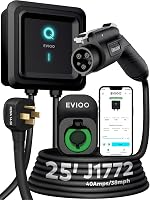
The EVIQO 48A Hardwired Charger fits this slot. It wires to a dedicated 60A, 240V circuit and delivers up to 48A, which EVIQO says is enough to charge most EVs fully overnight.
It also lets you set 50A on a dedicated 70A circuit by setting DIP switches 4 and 5.
The app side adds features a basic plug-in unit does not. You can start and stop charging, set the speed from 6A to 48A, schedule off-peak sessions, and track energy and cost per charge.
It needs a 2.4 GHz home WiFi network.
EVIQO builds in a glow-in-the-dark holster and a fully sealed IP66 housing, and the unit is certified UL, ETL, FCC and Energy Star. The J1772 connector works with non-Tesla EVs, and Tesla drivers use the adapter that comes with the car.
Because it is fixed in place, hardwiring is a poor fit for a renter or anyone who moves often. For most owners who plan to stay, though, it is the type to plan around.
Our best hardwired EV charger for home roundup compares more fixed units.
Pick hardwired when speed, not portability, is the goal.
Which type of home EV charger is fastest?
Level 2 hardwired is the fastest of the three types. On a 60A circuit it can deliver up to 48A, ahead of the 40A cap on the plug-in Level 2 models here and far ahead of Level 1.
The current rating, not the label, decides your real charging speed. Higher amps mean more miles added per hour.
The EVIQO hardwired unit tops this list at 48A, with an option to reach 50A on a 70A circuit. The Grizzl-E plug-in follows at 40A, and the Lectron Level 1 sits well below both at 15A on 120V.
Your car can also cap the result. A vehicle with a 32A onboard charger will not pull 48A even from a hardwired unit.
Check the car's limit before paying for a circuit you cannot use.
The circuit behind the charger sets a harder ceiling. A 60A breaker is what enables 48A on the EVIQO.
A 50A breaker keeps a plug-in unit at 40A. A 70A circuit is what the 50A setting needs.
For the fastest plug-in pick by current, see our 48 amp EV charger roundup of the top hardwired units.
Match the charger to both the car and the breaker, and the speed difference shows up overnight.
What wiring does each charger type need?
The wiring is the biggest difference between the types. Level 1 uses an existing 120V outlet, Level 2 plug-in uses a 240V outlet, and hardwired Level 2 needs a new dedicated circuit run to the panel.
Plan the circuit before you buy the charger, not the other way around.
Level 1 needs nothing new if a household outlet sits near where you park. The Lectron charger uses a NEMA 5-15 plug, so a standard wall socket is enough.
Level 2 plug-in needs a 240V outlet, most often NEMA 14-50. If the garage already has one, the setup is a plug-in job.
If not, an electrician runs the circuit and mounts the outlet.
Hardwired Level 2 skips the outlet and connects the charger straight to the circuit. The EVIQO wants a dedicated 60A, 240V circuit for its full 48A output.
That work falls to a licensed electrician installing to the National Electrical Code.
Whichever type you choose, the panel needs spare capacity for the full circuit. A panel that is already full may need an upgrade before any charger goes in.
For a broad view of what each type offers, our guide to the best EV chargers for home use compares popular models across all three.
Size the circuit first, then pick the charger that fits it.
Which type fits your driving habits?
Match the type to how far you drive and how long the car sits. Level 1 suits short, predictable daily trips.
Plug-in Level 2 suits regular commutes. Hardwired Level 2 suits long drives and two-car households.
Daily miles are the deciding number. Count a typical weekday, then add a buffer for errands and weather.
If you cover only a handful of miles a day and the car is parked all night, Level 1 often keeps pace. The Lectron's overnight top-up is enough to replace a light day of driving.
If you commute a fair distance, a 40A plug-in like the Grizzl-E refills the battery much faster. Its 28–30 miles per hour at 40A covers most overnight gaps with room to spare.
If you drive a lot, run two EVs, or want to add charge during short stops, the 48A hardwired EVIQO is the fit. Its higher current gives the most miles per hour of the three.
Battery size also matters. A large battery takes longer to fill at any speed, so a small-battery car can live happily on Level 1 while a big one benefits from hardwired Level 2.
Pick the slowest type that still covers your worst day, then step up only if you keep waking up short.
Can you mix charger types at home?
You can mix types, and some households do. A hardwired Level 2 in the garage plus a Level 1 unit kept in the trunk covers both home charging and travel.
A portable Level 1 is the useful second charger, because it needs only a wall outlet wherever you stop. The Lectron unit folds into a bag and plugs in at a rental or a friend's house.
A plug-in Level 2 adds flexibility in a second location. If you have a 240V outlet at a cabin or a second home, a Grizzl-E can move between them.
The hardwired EVIQO stays in one place, so it makes the most sense as the primary home charger rather than a travel unit.
Keep in mind that each charger draws from the panel. Two Level 2 units running at once can overload a service that was sized for one, so stagger your sessions or check the total load with an electrician.
Mixing types is about coverage, not redundancy. One fast home charger plus one slow travel charger covers nearly every case.
Use one charger for home base, and a portable unit for the road.
How we chose these chargers
Our score weighs specs, features and buyer feedback against what you are shopping for. For this guide, we looked at voltage, current, connector, cable length and how each type fits a real garage.
The three picks below each stand for one charger type, so you can see what that type offers before you commit.
The EVIQO hardwired unit scores highest at 8.4 because it pairs the fastest current with app control and a long cable. The Grizzl-E plug-in follows at 9 in its own plug-in role, with adjustable amperage that suits older panels.
The Lectron Level 1 scores 7.7 as the simplest, most portable option.
We kept the picks to one per type so the choice stays clear. If you want more options within a single type, the linked roundups compare several models at the same current.
Each pick uses the connector and circuit described in its specs, and we matched it to the home setup it suits best.
One pick per type keeps the decision simple.
Which home EV charger type should you pick?
Pick Level 1 if you drive short distances and have only a 120V outlet. Pick a Level 2 plug-in if you have or can add a 240V outlet and want faster overnight charges.
Pick a hardwired Level 2 if you want the fastest home charging and plan to stay.
For most owners with a garage and a long-term plan, a hardwired Level 2 is the one to aim for. It gives the most miles per hour and the most room to grow.
Renters and light drivers should start with Level 1 and move up when the daily miles demand it. Plug-in Level 2 sits in the middle for anyone who has the outlet but not the appetite for new wiring.
Those are the different types of home EV chargers in plain terms: one slow wall plug, one fast outlet charger, and one fastest fixed unit. Match the type to your miles and your panel, and the rest is picking the model.
For more context on how these chargers fit a home setup, our best EV charger for home guide covers the full field.
Frequently asked questions
Can I install a Level 2 charger myself?
A plug-in Level 2 charger on an existing 240V outlet is a simple plug-in job. A hardwired unit needs a dedicated circuit run to the breaker panel, which a licensed electrician should do.
Check local permits before any new wiring.
Do I need a 240V outlet already in my garage?
Not necessarily. If your garage has no 240V outlet, an electrician can add one, or you can choose a hardwired charger that runs a new circuit.
Either way, the panel must have enough spare capacity for the full circuit.
How long does a hardwired Level 2 charger take to charge?
A 48A hardwired charger on a 60A circuit adds the most miles per hour of the home options here, enough to refill most EVs overnight. Exact time depends on your car's onboard charger limit and how empty the battery is.
Is Level 1 charging enough for daily driving?
Level 1 works if you drive a modest number of miles a day and can leave the car plugged in overnight. For longer commutes or a bigger battery, the slower top-up rate means you may wake up short of a full charge.
What is the difference between a plug-in and a hardwired Level 2 charger?
A plug-in Level 2 charger connects to a NEMA 14-50 or similar outlet and can be unplugged or moved. A hardwired unit is wired directly to the circuit, so it stays in place but can run higher amperage on a larger breaker.