Do Home EV Chargers Need Servicing?
No, home EV chargers don't need scheduled servicing. A Level 2 charger is a sealed wall unit with no oil, filters or moving parts to replace, so there's no service interval to book. What you do need is a regular visual check of the cable, connector, mount and fault lights.
On this page (10 sections)
- Do home EV chargers need servicing on a schedule?
- What parts of a home EV charger wear out?
- How do you check a home EV charger at home?
- What do the charger's fault lights tell you?
- Do hardwired and plug-in chargers need different care?
- When should you call an electrician instead of a repair service?
- Do smart chargers need app or firmware upkeep?
- How often should you inspect the cable and connector?
- Which charger is easiest to live with long term?
- So, do home EV chargers need servicing?
No, home EV chargers don't need scheduled servicing. A Level 2 charger is a sealed wall unit with no oil, filters or moving parts to replace, so there's no service interval to book.
What you do need is a regular visual check of the cable, connector, mount and fault lights.
That's the short answer to do home EV chargers need servicing. The longer one is about knowing which parts wear, what the indicator lights mean, and when to call an electrician instead of a service technician.
Do home EV chargers need servicing on a schedule?
No, there's no scheduled service interval for a home charger. Unlike a car, a charger has nothing to top up or replace at set mileage.
The unit converts AC power from your panel and sends it down a cable, and that's the whole job.
The parts that do wear are mechanical: the cable jacket, the connector, and the holster or mount. A charger installed outdoors in sun, rain or freezing temperatures sees more wear than one in a dry garage.
Your main routine is a quick look every few months. Check the cable for cracks or flattened spots, the connector for bent pins or scorch marks, and the mount for loose screws.
That's the servicing a home charger actually gets.
What parts of a home EV charger wear out?
The cable and connector wear first, not the electronics. The charger body is sealed and has no user-serviceable parts inside.
The cable bends every time you coil it, and the connector plugs and unplugs daily.
A 23 ft cable like the one on the Lectron 48A Hardwired J1772 Charger stays flexible in cold weather, but repeated tight coiling still stresses the jacket near the plug. Hanging the cable on a holster rather than draping it over a hook reduces that strain.
The connector pins carry high current, so a loose or dirty plug can heat up. Wipe the pins with a dry cloth if they look dusty, and never force a connector that doesn't seat smoothly.
The holster deserves a mention too. It takes the daily wear that would otherwise land on the cable end, so a cracked holster or a mount that has worked loose lets the connector hang and pulls on the pins.
A unit that ships with a holster, like the Lectron, gives the cable a fixed resting place from day one.
How do you check a home EV charger at home?
Run a five-minute check every few months. It covers the cable, the connector, the mount and the status light.
No tools beyond a dry cloth are needed.
- Unplug the connector and look for cracks, cuts or crushed spots along the cable.
- Check the connector pins for bending, dark marks or debris.
- Wiggle the wall unit gently to confirm the mount screws are tight.
- Look at the status light for a fault pattern.
- Feel the cable and plug during a charge for unusual heat.
If the unit sits outside, do this more often in winter, when ice can stiffen the cable and snow can pack around the holster.
What do the charger's fault lights tell you?
The status light is the charger's own self-check, so read it before you assume something is broken. Most units use color or a blink pattern to report a ground fault, overcurrent or overheating condition.
A solid green or blue light usually means ready to charge. A red or flashing light points to a fault.
The Emporia Pro 48A Hardwired Charger has built-in GFCI protection and reports faults through its app and indicator light, so you can see what tripped.
The protections differ by unit, and knowing which ones yours has narrows the diagnosis. The Lectron 48A Hardwired J1772 Charger lists built-in protection against overheating, overcurrent, voltage faults and ground faults, and it restarts automatically after a power outage.
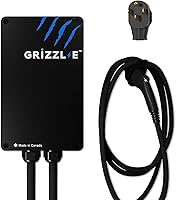
The Grizzl-E Level 2 240V / 40A Electric lists over current, over voltage, under voltage, ground fault and over temperature protection, plus power outage recovery and self-monitoring.
If a fault clears when you reset the breaker or reconnect the plug, watch it over the next few sessions. A fault that repeats needs an electrician's look, not a service call to the charger maker.
Do hardwired and plug-in chargers need different care?
Hardwired units skip the plug check; plug-in models add the outlet to your list. A hardwired charger like the Grizzl-E Level 2 240V / 40A Electric has no plug to inspect, so the cable and connector are the focus.
With a plug-in charger, also check the outlet for heat, looseness or scorch marks after a long charge. A warm plug is normal, but a hot outlet or a plug that wobbles is not.
If your hardwired charger needs a repair, the work is electrical and belongs to a licensed electrician. Our guide to the best hardwired EV charger for home covers what to look for in a unit that's built to stay put.
When should you call an electrician instead of a repair service?
Call a licensed electrician when the problem is the circuit, the breaker or the wiring. A charger has no serviceable internals, so a fault that isn't in the cable or connector points to the installation.
Signs to stop charging and get help:
- The breaker trips more than once.
- The wall unit or outlet feels hot to the touch.
- You see burn marks, a burning smell or sparking.
- The fault light stays on after a reset.
An electrician can check the breaker size and the circuit. A 48A hardwired unit needs a dedicated 240V circuit built for continuous load, which is a job for a professional.
The Grizzl-E Level 2 240V / 40A Electric lets you set the current to 40A, 32A, 24A or 16A to suit the circuit you have. That flexibility helps in older homes where the panel has less headroom.
Do smart chargers need app or firmware upkeep?
Smart chargers need occasional app and firmware updates, but that isn't servicing. It's software housekeeping you do from your phone.
The hardware stays sealed.
The Emporia Pro 48A Hardwired Charger pairs with the Emporia app for schedules, peak-rate avoidance and usage tracking. Keeping the app current helps those features work as intended.
Firmware updates usually arrive through the app or the unit's Wi-Fi connection. Check the app's settings menu every few months, and let the unit finish an update before starting a charge.
If your Wi-Fi drops, the charger still delivers power; you just lose the remote features until it reconnects. Reboot the router and the charger before assuming the unit has failed.
The same goes for Bluetooth on first setup: if pairing stalls, move closer to the unit and try again before you treat it as a fault.
How often should you inspect the cable and connector?
Check the cable and connector about every three months, and more often if the charger lives outdoors. A quick look catches wear before it becomes a safety problem.
Pay close attention to the spot where the cable meets the connector. That's where bending stress concentrates.
A cable that's cracked or has exposed wire should be replaced, not taped.
Keep the connector off the ground and in its holster when not in use. Dirt and moisture in the pins are a common cause of poor contact and heat.
If your unit sits outdoors in freezing weather, test the cable's flexibility by hand in winter: a jacket that has stiffened badly is a sign to check it more often.
Which charger is easiest to live with long term?
A charger with a long cable, a solid mount and clear fault reporting is the easiest to keep up. Those three things decide how much checking you'll actually need to do.
What to look for in a low-maintenance unit
Cable length matters more than it sounds. A 23 ft cable like the one on the Lectron 48A Hardwired J1772 Charger reaches the port without stretching, and the included holster keeps the end off the ground between charges.
A longer 25 ft cable on the Emporia Pro gives the same benefit in a wider driveway.
The Lectron also has an IP66 rating for indoor and outdoor use. Its ETL listing to UL 2594, UL 2251 and UL 2231 gives you a clear safety standard to point to.
Our roundup of the best EV chargers for home use compares units by amperage and install type. If your panel can't support 48A, look at a 40 amp EV charger instead.
A 48 amp EV charger is the faster pick when your electrical service can handle it.
So, do home EV chargers need servicing?
No, a home EV charger doesn't need scheduled servicing. It needs a quick visual check of the cable, connector and mount every few months, plus prompt action when a fault light or a tripping breaker shows up.
Pick a unit with a long cable, a holster and a clear fault indicator so the checks are easy. Then leave the wiring and breaker work to a licensed electrician.
That's the whole maintenance plan for most homes.
Frequently asked questions
How long does a home EV charger last?
Most home chargers are built to run for many years, and the warranty is the clearest signal of expected life. Lectron and Emporia both back their units with a 3-year manufacturer warranty.
Cable wear and connector damage are more common failure points than the electronics inside.
Does a home EV charger need an annual inspection?
No annual inspection is required, but a yearly check of the cable, connector pins and mounting screws takes a few minutes. If the unit sits outdoors or gets heavy daily use, look at it more often.
A licensed electrician should handle any wiring or breaker concerns.
Can I leave my home EV charger plugged in all the time?
Yes. A Level 2 charger draws power only during a charging session and goes idle afterward.
There's no need to unplug it between charges.
The exception is a charger that shows a fault light or keeps tripping its breaker, which should be looked at before the next session.
What should I do if my charger trips the breaker?
Reset the breaker once and note whether it trips again. Repeated trips point to a wiring, breaker or charger problem, so stop using the unit and have a licensed electrician check the circuit.
A hardwired charger rated for 48A needs a dedicated circuit sized for continuous load.
Do I need to service a hardwired charger differently from a plug-in one?
Hardwired units have no plug to inspect, so the checks focus on the cable, connector and mount. Plug-in models also need the outlet checked for heat or looseness.
Either way, there's no scheduled service, just routine visual checks and prompt repair if something looks worn.