7 Best Plug-In EV Chargers for Home (November 2026)
The best plug-in EV chargers for home include the ChargePoint HomeFlex NEMA 14-50 Charger for most garages, the VEVOR Level 1&2 EV Charger (best budget plug-in hybrid option), and the AIMILER 32A Wi-Fi NACS Charger for Tesla owners.
On this page (9 sections)
- The best plug-in EV chargers for home use
- How these plug-in chargers compare
- How we compared these home EV chargers
- What outlet do you need for a plug-in EV charger?
- How fast will a plug-in charger charge your EV?
- Do you need an electrician for a plug-in EV charger?
- Which plug-in EV charger fits your car's connector?
- What should renters and movers look for?
- Verdict: which plug-in EV charger should you buy?
The best plug-in EV charger for most homes is the ChargePoint HomeFlex NEMA 14-50, a 50A-capable Level 2 unit that plugs into a 240V outlet and charges up to 9x faster than a standard wall socket. Pick the AIMILER or EVIQO if you drive a Tesla, and a portable Level 1 and 2 model if you rent or move often.
No hardwiring is needed with these. You use an outlet that's already there, so the job is closer to plugging in a dryer than fitting a new circuit.
That makes plug in ev chargers for home use an easier first step for most drivers.
Our picks at a glance
-
1

-
2

-
3

- 4
 Check it
EVIQO 40A NACS Plug-In Charger
Best for overnight Tesla charging - 5
 Best for renters with a standard outletCheck it
- 6
 Check it
bokman Level 1 and 2 Portable Charger 16A
Best for road trips - 7
 Check it
EVDANCE Level 1 and 2 Portable Charger 25ft
Best for shared driveways
The best plug-in EV chargers for home use
Every pick here runs from an outlet rather than a fixed cable, so you can take it with you when you move. The ChargePoint is the fastest and most connected, and the rest cover Teslas, renters and tight budgets.
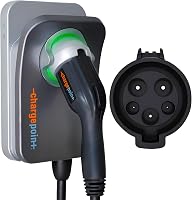
ChargePoint HomeFlex NEMA 14-50 Charger: Best for most garages
- J1772 connector for all non-Tesla EVs
- NEMA 14-50 plug on a 40A or 50A circuit
- Up to 45 mi/hr
- ChargePoint app and 274k+ station network
ChargePoint's HomeFlex suits a garage with a NEMA 14-50 outlet already on a 40A or 50A circuit. It's the strongest all-round pick because it pairs 45 miles per hour of charging with the largest app network in this group.
The J1772 connector fits all non-Tesla EVs. Tesla drivers can use it too, but they need an adapter.
The 23 ft cable is shorter than some portable rivals, so measure the run from outlet to charge port before you buy. The unit offers 16/24/32/40/48/50A settings on 240V, so it can be dialed down to match a smaller panel.
The app controls the charger, manages reminders, connects to smart home devices, finds stations and tracks charging data. ChargePoint also notes CarPlay and Android Auto support for station info on the road.
The company says the unit is UL-certified and includes a cold-resistant cable for outdoor installs.
Its real trade-off is installation. ChargePoint asks buyers to use a licensed electrician to match breaker and wire sizing to the HomeFlex's amperage.
That's more setup than a portable unit, though it's the right call for a 50A load. Our level 2 charger for home guide walks through the circuit sizing.
VEVOR Level 1&2 EV Charger: Best budget plug-in hybrid option
- 16 A J1772 portable charger
- NEMA 6-20P plug with NEMA 5-15 adapter
- 25 ft cable and carrying bag
- IP66 waterproof control box
VEVOR's 16A unit is the pick for plug-in hybrid owners and short-commute drivers who want a low-cost charger. It's a Level 1 and 2 portable charger that runs from a NEMA 6-20 outlet or the included NEMA 5-15 adapter.
At 16A on 240V it adds a modest charge compared with a 40A station. For a plug-in hybrid with a small battery, that's often enough to cover daily driving.
The 25 ft cable and carrying bag also make it easy to move between the garage and a second parking spot. The unit weighs 6.8 pounds and measures about 9.7 by 3.8 by 2.3 inches, so it stows in a trunk without crowding it.
VEVOR says the control box is IP66 waterproof and the smart chip protects against surges, leaks, grounding faults, overvoltage, undervoltage, overcurrent, overheating and overcharging. An LED indicator shows status at a glance.
Its trade-off against the ChargePoint is speed and smart features. There's no app or scheduling, so a timer on the car or outlet does the off-peak work instead.
That's a fair swap for a budget buyer.
AIMILER 32A Wi-Fi NACS Charger: Best for Tesla owners
- NACS connector for Tesla and NACS EVs
- 32 A, adjustable from 16 A
- NEMA 14-50 plug, 25 ft cable
- Wi-Fi app and touch screen
AIMILER's 32A charger is the best fit for Tesla owners who want app control without paying for a wall unit. The NACS connector plugs straight into a Tesla or another NACS car, with no adapter.
AIMILER also lists NACS-port models like the Kia EV6 and EV9 and the Nissan Ariya as fits.
It's a plug-in Level 2 charger with Wi-Fi, so you can set the amperage from 16A to 32A in the app or on the touch screen. Charging speed depends on the circuit: 32A needs a 40A breaker, 24A needs 30A and 16A needs 20A.
Check your outlet's breaker before you plan around the top speed. Adjust the current before you start charging, because AIMILER doesn't allow changes mid-session.
The 25 ft cable reaches across most garages. AIMILER lists NEMA Type 4 protection and a built-in CCID-20 leak detection device, so a separate GFCI breaker isn't required.
The app tracks charging cost and history and sends a fully-charged notice.
The trade-off is its connector: J1772 cars need a Tesla-to-J1772 adapter. Drivers with a non-Tesla EV should look at a J1772 station or a portable unit instead.
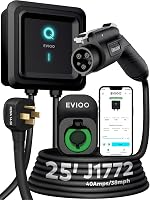
EVIQO 40A NACS Plug-In Charger: Best for overnight Tesla charging
- 40 A NACS plug-in charger
- NEMA 14-50 outlet on a dedicated 50A circuit
- 25 ft cable
- IP66 and NEMA 4 housing
EVIQO's 40A NACS charger is the top pick for Tesla drivers who want the fastest overnight charge from a standard outlet. It delivers up to 40A on a dedicated 50A NEMA 14-50 circuit, which is enough to fill most Teslas overnight.
The plug has a button that opens the Tesla charge port, so you don't have to reach for the car's screen. The 25 ft cable and the glow-in-the-dark holster help in a dark garage.
EVIQO notes a stronger built-in antenna to keep the charger online in a garage or basement.
EVIQO says the unit is certified to UL, ETL and Energy Star standards, and the IP66 and NEMA 4 housing handles rain and snow. The app sets speed from 6A to 40A, schedules off-peak charging and tracks energy cost.
It needs a 2.4 GHz Wi-Fi network. A side reset button restarts the unit without a trip to the breaker.
Against the AIMILER, it adds speed and a higher weather rating, but costs more. If your panel only supports 32A, the AIMILER is the smarter buy.
Lectron Level 1 Charger 15A: Best for renters with a standard outlet
- 15 A Level 1 J1772 charger
- Standard NEMA 5-15 plug
- 16 ft extension cord
- IP65 rated
Lectron's 15A charger is the right choice for renters who only have a standard wall outlet. It plugs into a NEMA 5-15 socket and adds about 40 to 50 miles of range over an overnight charge.
That's Level 1 charging at 120V, so it's slow. The unit draws 15A and 1.65 kW.
For a driver covering 30 to 40 miles a day, one overnight session covers the commute. For longer daily drives, it falls short.
At 2.93 kg it's light enough to coil up and carry inside.
The 16 ft extension cord gives some reach from the outlet. Lectron says the unit is ETL-certified to UL2594 and FCC-certified, with IP65 dust and water resistance.
The J1772 connector fits all J1772 EVs, but Teslas need an adapter. Lectron covers it with a 2-year warranty.
Its trade-off is speed against every other pick here. If you can install a 240V outlet, a Level 2 unit pays off quickly.
If you can't, this is the simplest safe option. Our best EV chargers for home use roundup compares more Level 2 choices.
bokman Level 1 and 2 Portable Charger 16A: Best for road trips
- 16 A portable Level 1 and 2 charger
- NEMA 6-20P plug with NEMA 5-15 adapter
- 20 ft cable
- Delay timer and 6 to 16 A settings
bokman's portable charger suits drivers who want one unit for the garage and the road. It's a 16A Level 1 and 2 charger with a NEMA 6-20 plug and a NEMA 5-15 adapter for standard outlets.
It weighs 7.65 pounds.
The 20 ft cable spans a typical parking space. A 1 to 12 hour delay timer lets you charge off-peak, and the current adjusts from 6A to 16A.
Settings lock in, so you don't reset them each time. bokman says the unit works with NEMA 6-20, 5-15 and 5-20 outlets but not 6-30.
bokman uses physical buttons and an LED screen rather than a touchscreen or app. That's easier in cold weather and gloves.
The unit is ETL-certified with IP65 protection and works from -22 F to 130 F. The housing carries GFCI, over-voltage, over-current, surge, short-circuit and over-temp protection.
The trade-off is that it tops out at 16A. For a full-size EV with a large battery, that's a slow daily fill.
It's the best fit as a travel charger or a backup for a second home.
EVDANCE Level 1 and 2 Portable Charger 25ft: Best for shared driveways
- 16 A Level 2 and 12 A Level 1 charging
- NEMA 6-20 plug with 5-15 adapter
- 25 ft cable
- IP66 rated control box
EVDANCE's 25 ft portable charger suits households with two cars sharing one driveway outlet. The longer cable lets you reach a second parking spot without moving the car.
It offers 12A on 120V and 16A on 240V from the same unit. On a NEMA 6-20 outlet it adds about 10 to 12 miles per hour at 3.68 kW.
On a standard 5-15 outlet that drops to 2 to 5 miles per hour. The unit weighs 7 pounds.
The control box is IP66 rated with a UL 94 V-0 fire rating. An LED display shows status and errors.
EVDANCE gives a 1-year warranty. The company also warns that the charger syncs to your car's onboard current limit, so a car that caps its draw will charge below 16A.
Its main trade-off is outlet compatibility. It works with NEMA 5-15, 5-20 and 6-20 outlets, but not with 14-50 or 6-50 sockets unless you buy an adapter.
Drivers with a 14-50 outlet in the garage should pick a unit built for it. For more on circuit size, see our 40 amp EV charger picks.
How these plug-in chargers compare
The table lines up the outlet type, amperage and connector for each pick, which are the three facts that decide whether a charger works in your garage. Speed follows from them.
A 14-50 unit at 40A or 50A will outrun any 16A portable, but the portable needs only a 6-20 or 5-15 socket that may already be on the wall. Connector type is the other gate: J1772 covers most non-Tesla EVs, while NACS covers Teslas and newer NACS cars.
Cable length and weather rating separate the near-equal units, since a 25 ft cable reaches more parking spots and an IP66 housing handles more weather than IP65.
| Product | Best for | Amperage | Input voltage | Cable length | Our score |
|---|---|---|---|---|---|
| ChargePoint HomeFlex NEMA 14-50 Charger | most garages | 50 A | 240 volts | 23 ft | 8.6 |
| VEVOR Level 1&2 EV Charger | budget plug-in hybrid option | 16 A | 120 to 240 volts | 25 ft | 8.5 |
| AIMILER 32A Wi-Fi NACS Charger | Tesla owners | 32 A | 240 volts | 25 ft | 7.9 |
| EVIQO 40A NACS Plug-In Charger | overnight Tesla charging | 40 A | 240 volts | 25 ft | 7.7 |
| Lectron Level 1 Charger 15A | renters with a standard outlet | 15 A | 120 volts | 16 ft | 7.7 |
| bokman Level 1 and 2 Portable Charger 16A | road trips | 16 A | 120 to 240 volts | 20 ft | 7.7 |
| EVDANCE Level 1 and 2 Portable Charger 25ft | shared driveways | 16 A | 120 to 240 volts | 25 ft | 7.6 |
How we compared these home EV chargers
We ranked these by the facts that change daily use: outlet type, amperage, connector, cable length and weather rating. A charger only works at its top speed if your outlet and circuit support it, so we weighted outlet fit heavily.
A 40A station on a 14-50 outlet earns more than a 16A unit when the buyer has the circuit, and a 16A portable earns more when the buyer doesn't.
We also weighed smart features and safety listings. A Wi-Fi app with scheduling saves money on off-peak rates, and a UL or ETL listing matters for a unit that runs unattended overnight.
Our scores weigh specs, features and how well each unit fits what a home buyer needs. Adjustable amperage counted in favor of units like the ChargePoint and AIMILER, since it lets one charger match more panels.
Cable length got real weight too. A 25 ft cable reaches more parking spots than a 16 ft one, and that difference decides whether you can charge without moving the car.
Price tiers were treated as a trade-off against speed and features, not as a score on their own.
What outlet do you need for a plug-in EV charger?
A NEMA 14-50 outlet on a 40A or 50A circuit is the usual choice for a fast plug-in charger. Smaller portable units use a NEMA 6-20 or a standard 5-15 outlet and charge more slowly.
The outlet decides your ceiling. A 14-50 socket lets a Level 2 unit run at 40A or more.
A 6-20 socket caps a portable charger at 16A. A 5-15 socket gives you Level 1 speeds only.
Match the charger's plug to the socket before anything else, because an adapter only bridges the shape, not the current limit.
NEMA 14-50: the fast option
This is the four-prong outlet used for ranges and RVs. ChargePoint, AIMILER and EVIQO all offer versions that plug into it.
The HomeFlex runs on a 40A or 50A circuit, and the EVIQO asks for a dedicated 50A circuit. If your garage already has one, a 14-50 unit is the fastest route to a full battery overnight.
EVIQO specifically warns that a dryer outlet won't do; it needs the RV or range type.
NEMA 6-20: the portable middle ground
VEVOR, bokman and EVDANCE use this smaller 240V outlet. It supports 16A charging, which adds about 10 to 12 miles per hour.
It's a good fit for a plug-in hybrid or a second car that doesn't need a full charge every night. EVDANCE notes you can reach a 6-20 socket from a 14-50 outlet only with a separate adapter.
NEMA 5-15: the standard wall socket
Lectron's Level 1 unit and the adapter modes on the portables use this everyday outlet. Charging is slow, at 1.65 kW or less.
It works for renters and low-mileage drivers, and as an emergency top-up on the road. VEVOR and bokman both include a 5-15 adapter in the box.
How fast will a plug-in charger charge your EV?
A 40A Level 2 charger adds up to about 45 miles of range per hour. A 16A portable unit adds about 10 to 12 miles per hour, and a 15A Level 1 charger adds far less.
EVDANCE puts its 120V mode at 2 to 5 miles per hour.
Those figures assume the car accepts the full current. Some EVs limit what they draw, so the charger's rating is a ceiling, not a promise.
ChargePoint states its 45 mi/hr figure is dependent on the vehicle. AIMILER makes the same point in a different way: its 32A top speed needs a 40A breaker, and the charger steps down to 24A or 16A on smaller circuits.
For planning, match the charger to your daily drive. If you cover 40 miles a day, a 16A unit charging overnight is enough.
If you cover 100 miles or more, or have a large battery, a 40A or 50A station saves you from topping up during the day. Our 40 amp EV charger guide covers the faster end of the range.
Do you need an electrician for a plug-in EV charger?
You don't need an electrician to plug the charger in, but you do need the right outlet on a dedicated circuit. If the outlet isn't there, an electrician has to install it.
The outlet install is the part that needs a licensed trade. A 14-50 socket for a 50A charger needs correct breaker and wire sizing.
ChargePoint asks buyers to use a licensed electrician for exactly this reason. AIMILER's 32A unit needs a 20A to 40A circuit depending on the amperage you pick, so the breaker choice matters there too.
Once the outlet is in place, plug-in chargers are simple. You mount the unit or holster, plug the cable into the outlet, and connect the car.
The portable models need even less: find an outlet and go. That's the main reason plug in ev chargers for home use appeal to renters and movers.
If your panel can't spare a 40A or 50A circuit, a 16A portable on a 6-20 outlet is the practical fallback.
Which plug-in EV charger fits your car's connector?
Match the connector first. J1772 fits most non-Tesla EVs, and NACS fits Teslas and newer NACS cars.
A mismatch needs an adapter, and not every charger includes one. The adapter also adds bulk at the charge port, which some drivers find awkward in tight garages.
ChargePoint, VEVOR, Lectron, bokman and EVDANCE use J1772. AIMILER and EVIQO use NACS.
Tesla drivers can still use a J1772 charger with an adapter, and J1772 cars can use a NACS charger with a Tesla-to-J1772 adapter. Neither adapter comes in the box with these units.
ChargePoint spells this out in its own product notes for Tesla owners.
Check the charge port on your car before you order. A NACS plug won't fit a J1772 port without an adapter, and the adapter adds cost and a bulky connector at the port.
Buy the charger that matches your car and you skip that step. EVDANCE also lists a few models its charger doesn't suit, so confirm your car on the compatibility list first.
What should renters and movers look for?
Renters should pick a portable Level 1 and 2 charger that runs from an outlet already in the home. VEVOR, bokman and EVDANCE fit that need, and Lectron covers standard outlets only.
Portability matters for two reasons. First, you can take the charger with you when you move.
Second, you avoid paying for a hardwired install in a home you don't own. Our hardwired EV charger guide covers the fixed alternative if you do own the place.
Look for a carrying bag, a long cable and an adapter for standard outlets. Those three features make a portable unit usable in more homes.
A delay timer also helps if your utility charges less at night. bokman builds the timer into the unit, while EVDANCE relies on the car's own schedule. A weather rating is worth checking too if the outlet sits outside, since an IP65 or IP66 control box handles rain and dust better than a bare unit.
Verdict: which plug-in EV charger should you buy?
For most homes, buy the ChargePoint HomeFlex NEMA 14-50. It's the fastest unit here, it has the deepest app and support network, and it runs from a standard 14-50 outlet.
Tesla owners should pick the EVIQO for speed or the AIMILER for app control on a smaller circuit. Renters and plug-in hybrid drivers should take a portable unit, with VEVOR as the best budget pick and bokman as the best travel charger.
These plug in ev chargers for home cover every outlet type, so pick the one that matches the socket you have and the miles you drive each day.
Our top 3 picks at a glance
-
1
-
2
-
3
Frequently asked questions
What outlet does a plug-in Level 2 EV charger use?
The most common is a NEMA 14-50 outlet on a 40A or 50A circuit. Some portable chargers use a smaller NEMA 6-20 outlet.
Check your car's connector type and the outlet you have before you buy, because a Level 2 charger won't run at full speed on a 120V socket.
How fast is a plug-in EV charger at home?
It depends on the amperage and the outlet. A 16A portable unit adds about 10 to 12 miles per hour on 240V.
The ChargePoint HomeFlex reaches up to 45 miles per hour on a 40A or 50A circuit.
A 15A Level 1 charger on 120V adds far less.
Can I use a plug-in EV charger for a Tesla?
Yes, but the connector has to match. A NACS charger like the AIMILER or EVIQO plugs straight into a Tesla.
A J1772 charger needs a Tesla adapter.
Tesla cars also work with a J1772 charger once you add the adapter.
Can a plug-in EV charger be used outdoors?
Many can. Look for an IP rating on the housing.
IP65 and IP66 models handle rain and dust.
ChargePoint says its HomeFlex can be installed indoors or outdoors.
Always check the outlet's own weather protection before leaving a charger outside.
Is a portable EV charger good enough for everyday home charging?
It can be. A portable Level 1 and 2 charger plugs into an existing 240V outlet and adds a usable overnight charge.
It won't match a fixed Level 2 unit's top speed.
Choose a portable model if you rent, move between homes or want a backup in the car.