Level 2 Charger for Home: Amps, Plugs and What to Buy
Choose a Level 2 charger for home use by matching its output to your circuit, outlet and car. A plug-in 40A unit suits a compatible 50A circuit, while hardwired models can support higher output when your panel and electrician allow it.
On this page (9 sections)
- What does a Level 2 charger do at home?
- How many amps should a home EV charger have?
- Should you choose plug-in or hardwired?
- Which connector fits your EV?
- Which home Level 2 charger fits your setup?
- What should you check before installation?
- What will a Level 2 charger cost to run?
- Do you need a smart charger?
- How should you choose a Level 2 charger for home?
Choose a Level 2 charger for home use by matching its output to your electrical circuit, outlet and car. A plug-in 40A unit suits a compatible 50A circuit, while hardwired models can support higher output when your panel and electrician allow it.
The charger cannot make your car accept power faster than its onboard charger allows. Your daily driving, overnight parking time and installation options matter as much as the advertised amps.
Start by checking the car's port and maximum AC charging rate, then have an electrician assess the panel and proposed circuit. For a basic explanation of the equipment, see what a Level 2 EV charger is.
What does a Level 2 charger do at home?
A Level 2 charger uses a 240V supply to charge an EV faster than a regular 120V household outlet. The actual charging rate depends on the charger, circuit and vehicle.
Think of the setup as a chain: the circuit supplies power, the charger manages it, and the car's onboard charger sets how much AC power it can take. The lowest limit in that chain determines the result.
A Level 2 unit can suit home use if you park for several hours and want to add more range overnight. To estimate your own schedule, compare your battery size and driving needs with our guide to how long it takes to charge an EV at home.
How many amps should a home EV charger have?
Choose the highest output your car and electrical installation can both use, rather than buying the biggest number available. A 40A charger is a common plug-in choice; 48A or 50A output may require a hardwired installation and a larger circuit.
| Charger output | Typical installation question | What to check |
|---|---|---|
| 16–24A | Can a lower-output setup meet your daily needs? | Vehicle rate, circuit and charging time |
| 32A | Does the circuit support this continuous load? | Breaker and wiring approval |
| 40A | Is there a compatible 50A circuit? | Outlet type and circuit condition |
| 48–50A | Can the panel and wiring support the required circuit? | Hardwired installation and electrician's assessment |
The table is a guide to questions, not a wiring plan. Circuit sizing, local code and the charger's installation instructions control what is allowed.
A charger rated for more amps does not guarantee a faster session. If the car accepts less AC power than the charger can supply, the car is the limit.
Our 40 amp vs 48 amp charger comparison explains when the extra output may matter. If the panel is tight on capacity, ask about EV charger load management before assuming a new service upgrade is the only option.
How do you match charger amps to a circuit?
Match the charger to the circuit rating in the configuration approved by its manufacturer and electrician. The Grizzl-E Classic specifies 40A output on a 50A breaker.
Do not select a breaker from the charger name alone. The wire, breaker, outlet, installation method and local requirements all need to work together.
A panel label or old outlet can give an electrician useful information, but it does not prove the circuit is suitable for sustained charging. Ask for a site assessment before you order a plug-in model.
Does the car's onboard charger affect speed?
Yes, the vehicle's onboard charger limits how quickly it can take AC power. A higher-amp wall unit cannot override that limit.
Check the owner's manual or vehicle maker's specifications for the car's maximum AC charging rate. If you may replace the vehicle soon, consider whether the next car will use more power, and balance that against the cost and capacity of the electrical work.
Should you choose plug-in or hardwired?
Choose plug-in if you already have a suitable 240V outlet and want a charger that can be unplugged. Choose hardwired if you want a permanent installation or need the higher output available from some models.
A plug-in charger is only as suitable as the outlet and circuit behind it. An old, worn or incorrectly wired outlet can create risk under long charging sessions, so have it checked rather than relying on its appearance.
Hardwired equipment connects directly to the circuit. It usually calls for professional installation, and the electrician can confirm whether the panel and wiring support the charger's intended output.
| Setup | Often a fit for | Confirm before buying |
|---|---|---|
| NEMA 14-50 plug | A compatible four-prong 240V outlet | Dedicated circuit, outlet condition and continuous-duty suitability |
| NEMA 6-50 plug | A compatible three-prong 240V outlet | Correct outlet and circuit rating |
| Hardwired | Permanent installation or higher output | Panel capacity, wiring path and required breaker |
For a closer look at plug choices, read which outlet a Level 2 EV charger needs. Do not treat a dryer outlet as interchangeable with a 14-50 outlet; the configurations differ.
Which connector fits your EV?
Check the charge port on your vehicle, not just the brand name. J1772 is common on many non-Tesla EVs, while Tesla vehicles and many newer EVs use NACS.
A J1772 charger can work with a Tesla when you have the right adapter. Some Teslas include a J1772 adapter, but confirm your own vehicle's equipment and compatibility.
NACS adoption means connector choices are changing across model years. Before buying, check the owner's manual or ask the automaker which connector your car uses and whether an adapter is approved.
The four chargers below use J1772 connectors or are described as compatible with North American EVs and PHEVs. If you are shopping for a Tesla, review how to choose a Level 2 charger for a Tesla and confirm the adapter you need.
Which home Level 2 charger fits your setup?
The right model depends on whether you need a plug-in unit, hardwired installation, smart controls or adjustable amperage. These options cover those different needs; check your circuit and vehicle before choosing.
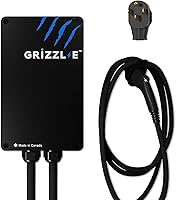
Grizzl-E Classic: adjustable output with a NEMA 14-50 plug
The Grizzl-E Classic is a plug-in option for a home with a suitable NEMA 14-50 outlet and circuit. Its output can be set to 40A, 32A, 24A or 16A.
It has a 24 ft cable and a metal case enclosure. Grizzl-E describes it as suitable for indoor or outdoor use and lists protections including overcurrent, ground fault and overtemperature protection.
Choose it if you want adjustable output and have the right plug-in setup. The 40A setting calls for a 50A circuit breaker, while its lower settings correspond to smaller breaker ratings in the product information.
Emporia 48A: hardwired J1772 charging with Wi-Fi
The Emporia charger is a 48A hardwired J1772 option with a 25 ft cable and 2.4 GHz Wi-Fi features. Emporia recommends professional installation.
The app can show energy data and manage charging schedules. Its J1772 connector is intended for EVs with that port; Tesla and NACS drivers should check for the matching Emporia connector or a compatible adapter.
Choose it if you want 48A output and connected controls, provided the electrician confirms your panel and circuit can support the setup. Emporia recommends the hardwired option for homes with GFCI breakers.
ChargePoint HomeFlex: hardwired output and app controls
The ChargePoint HomeFlex is a hardwired J1772 charger with adjustable current from 16A to 50A. Wi-Fi is needed for certain app functions, and ChargePoint says an electrician should install the unit.
The charger works with non-Tesla EVs using J1772; Tesla drivers need an adapter. Check your vehicle's port and the circuit requirements before choosing the 50A setting.
Choose it if you want app features and a hardwired installation. Its app can manage reminders, charging information and smart-home connections.
EVIQO 40A: plug-in charging with app scheduling
The EVIQO is a J1772 charger rated up to 40A that plugs into a NEMA 14-50 outlet. It has a 25 ft cable and a 6A to 40A adjustment range through its app.
EVIQO says the unit can be used indoors or outdoors and has an IP66 / NEMA 4 housing. Its app requires 2.4 GHz Wi-Fi, so check the signal where the charger will sit.
Choose it if you want a plug-in 40A unit with scheduling controls. Confirm that your outlet is a four-prong NEMA 14-50 on a dedicated 50A circuit, not a dryer outlet.
What should you check before installation?
Check the panel, wiring route, mounting spot, Wi-Fi and cable reach before buying. Those details can change which charger makes sense and what installation work is needed.
Ask an electrician to review:
- Whether the panel has capacity for the charger and other large loads.
- Whether the circuit needs to be new or can use existing wiring.
- The outlet, breaker and wire condition for a plug-in charger.
- The charger setting and circuit size that meet local requirements.
- Any permit or inspection requirements in your area.
Decide where you will park and how the cable will reach the car's charge port without crossing a walkway or creating a trip hazard. Measure the path with the vehicle in its usual position.
If the charger uses Wi-Fi, check the signal at the intended mounting point. Smart features may depend on a stable connection, and a garage or basement can weaken the signal.
Outdoor placement can work with equipment rated for it, but installation still needs to follow the unit's instructions and local rules. See whether you can charge an EV in the rain for weather and charging precautions.
What will a Level 2 charger cost to run?
Your home charging cost depends on the electricity your car uses and your utility rate. The charger itself does not set the price per kilowatt-hour.
To estimate a session, multiply the energy added in kilowatt-hours by your electricity rate. Your actual energy use may be higher than the battery energy added because charging has losses.
If your utility offers time-of-use rates, scheduling may help you charge during lower-cost hours. Check the rate plan and any fees before changing your charging routine.
Use our guide to the cost to charge an EV at home for a worked estimate based on your own rate and vehicle. Compare the charger purchase and installation costs separately from ongoing electricity use.
Do you need a smart charger?
A smart charger is useful if you want app controls, charging schedules or energy tracking. A simpler charger may be enough if your car already handles schedules and you do not need remote controls.
Check which features require Wi-Fi and whether they duplicate settings in your vehicle. Scheduling in both places can be confusing if the car and charger use different start times.
Smart charging can help align a session with a utility's off-peak window, but it does not guarantee a lower bill. Your rate plan determines whether shifting the session changes the cost.
How should you choose a Level 2 charger for home?
Pick a plug-in 40A charger if you already have a suitable NEMA 14-50 outlet and dedicated circuit. Pick a hardwired 48A or 50A model if an electrician confirms your panel and vehicle support that setup.
Choose adjustable output if you need to match a lower circuit limit, and verify the car's connector before ordering. For more options across installation styles, see our best EV chargers for home use guide.
Frequently asked questions
What amperage Level 2 charger should I get for home?
Choose an amperage your dedicated circuit can support, then check your vehicle's maximum AC charging rate. A 40A charger needs a 50A circuit under the configurations described here.
Higher output may need a hardwired connection and a larger circuit.
Have an electrician assess your panel and wiring before buying.
Is a 40A or 48A home charger better?
A 48A charger can deliver more power if your vehicle accepts it and your electrical system supports the required circuit. A 40A unit may be the simpler fit for an existing compatible 50A outlet.
Compare installation needs and vehicle limits before paying for higher output.
Do I need a NEMA 14-50 outlet for a Level 2 charger?
You need a compatible 240V connection, but it does not have to be a NEMA 14-50 outlet if you choose a hardwired charger. Plug-in models such as 14-50 units require the matching outlet and circuit.
Confirm the outlet type and circuit rating before ordering.
Can I use a J1772 charger with a Tesla?
A J1772 charger can work with a Tesla when you have a compatible adapter. Check your vehicle's included equipment and port before buying, since connector needs vary by vehicle and model year.
Newer EVs may use NACS, so verify the charge port in your owner's manual.
Should I install a home EV charger myself?
Ask a licensed electrician to assess and install a new 240V circuit or hardwired charger. An existing outlet still needs to be suitable for continuous EV charging, correctly wired and on a dedicated circuit.
Do not assume a dryer or range outlet is safe to share.